You have narrowed it down to three names: 51Talk, Novakid, and Cambly Kids. All three are online English platforms for children, all three have decent reviews, and all three show up in the same search results. So what is actually different about them, and which one is the right fit for a Saudi child who needs to work on English pronunciation?
That is a sharper question than it looks. Pronunciation is not the same as vocabulary or grammar. It requires consistent, specific correction across many sessions, not just general English exposure. The format and structure of a platform matter enormously for whether Arabic transfer errors, the /p/ for /b/ swap, the /v/ for /f/ substitution, the /ch/ and /sh/ confusion, actually get addressed or just quietly ignored.
This page compares the three platforms across the criteria that matter most for pronunciation specifically. It is not a general ranking. Novakid and Cambly Kids are solid platforms for other goals. But if Arabic-English pronunciation correction is your primary concern, the structural differences between these platforms are worth understanding before you sign up.
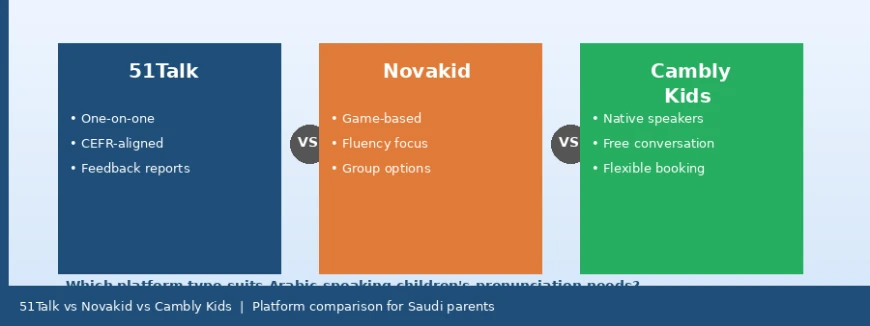
What Each Platform Actually Is
Before comparing them, it helps to understand what each platform was built to do, because that shapes everything else.
51Talk
51Talk is a live one-on-one English platform that pairs children with a single qualified teacher for structured 25-minute sessions. The curriculum follows CEFR levels and Cambridge English learning goals. Each lesson includes a pre-class warm-up, a live session, post-class review exercises, a teacher feedback report, and regular unit assessments. The platform is designed for systematic language development, with clear level progression and documented outcomes per session.
Novakid
Novakid is a game-based English platform for children aged four to twelve, built around engaging, visually rich lessons designed to feel more like play than class. It offers both one-on-one and group lesson formats depending on the plan. Teachers are qualified and the curriculum is proprietary to the platform. The emphasis is on engagement and fluency building, with progress tracked through levels and badges rather than formal reports. It is a strong choice for children who disengage quickly in traditional lesson formats.
Cambly Kids
Cambly Kids connects children with native English-speaking tutors through a flexible, on-demand booking system. There is no fixed curriculum. Sessions are conversational and can be guided by the parent’s or child’s interests. The platform is well suited to children who already have a decent foundation and want more natural speaking exposure, or to children in environments where hearing authentic native-speaker English is otherwise limited. Correction depth depends heavily on the individual tutor.
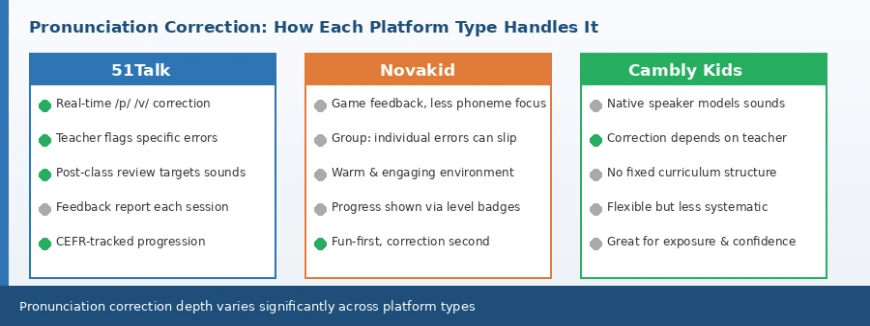
How Each Platform Handles Pronunciation Correction
This is the key question for Saudi parents whose children produce Arabic-influenced errors in English. The answer is not the same across all three platforms, and the differences are structural, not just a matter of teacher quality.
51Talk: correction built into the format
The one-on-one structure means the teacher hears every word the child produces. A child who says “ben” instead of “pen” cannot slip past unnoticed. The teacher can address the substitution immediately, explain the mouth position, drill the target sound, and note it in the post-class feedback report for follow-up in the next session. The post-class review exercises then revisit the same sounds the child worked on in the live session, which is how motor-level pronunciation changes actually happen: repetition spread across multiple short sessions, not one long one.
The CEFR alignment also means there is a progression structure. Pronunciation work is embedded in the curriculum rather than treated as an optional add-on.
Novakid: engagement first, correction varies
Novakid’s strength is getting children to speak without anxiety. That is genuinely valuable, especially for younger children or those who have become reluctant speakers after negative experiences in group classes. But the game-first format means pronunciation correction tends to be lighter. In group sessions particularly, a child who substitutes /b/ for /p/ consistently may never have that pattern explicitly addressed. In one-on-one Novakid sessions, it depends more on the individual teacher’s approach than on a platform-level system.
If your child is not yet willing to speak at all in English, Novakid’s approach to building that willingness is worth considering. But if the goal is to eliminate specific Arabic transfer errors, the correction structure is not as reliable.
Cambly Kids: native input, inconsistent correction
The biggest asset of Cambly Kids for pronunciation is exposure. Children hear authentic native-speaker rhythm, intonation, and connected speech in every session. That passive input matters, especially for prosody, the stress and melody of English, which is hard to develop without real listening exposure.
The limitation is that there is no curriculum, no standard reporting, and no built-in mechanism for tracking which specific sounds a child is struggling with across sessions. One tutor might drill /p/ vs /b/ carefully. The next might focus entirely on conversation flow and never mention it. For systematic pronunciation correction, that inconsistency is a problem.
Platform Comparison at a Glance
This table sets out the key features of each platform across the dimensions that matter most for Arabic-speaking children working on English pronunciation.
| 51Talk | Novakid | Cambly Kids | |
| Session format | One-on-one only | One-on-one and group options | One-on-one (freelance teachers) |
| Session length | 25 minutes | 25-50 minutes | Flexible (per booking) |
| Teacher type | Qualified EFL teachers | Qualified/certified teachers | Primarily native English speakers |
| Curriculum structure | CEFR-aligned, Cambridge goals | Proprietary gamified curriculum | No fixed curriculum |
| Pronunciation focus | Explicit, tracked per session | Incidental within lessons | Depends on teacher |
| Arabic transfer errors | Corrected in real time 1-on-1 | May be missed in group sessions | Correction varies by teacher |
| Post-class review | Yes, sound-specific exercises | Game-based review activities | No structured review |
| Feedback reports | Written per session | Progress shown via badges/levels | No standard reporting |
| Trial lesson | Available (check 51talk.com) | Trial lesson available | Pay-per-lesson, flexible |
| Best suited for | Systematic pronunciation work | Engagement and fluency building | Exposure and conversation practice |
Which Platform Fits Which Situation
The right platform depends on where your child is right now, not just which one has the best reviews. Here are the most common situations Saudi parents describe and which platform type matches each one.
My child has specific Arabic transfer errors that need fixing
This is the clearest case for 51Talk. The one-on-one format, the documented feedback per session, and the structured review between lessons all point in the same direction: systematic correction of specific phoneme errors. If /p/, /v/, /ch/, and /sh/ are the problem, you need a format where every production is heard and every error is tracked. That is a structural feature, not a teacher quality question.
My child refuses to speak English and needs to enjoy it first
Novakid is worth trying. The game-based format lowers the stakes considerably, and children who have become self-conscious about their pronunciation often open up in an environment that feels more like play. If engagement is the bottleneck, fixing it first makes everything else more productive. You can always move to a more structured programme once the willingness to speak is there.
My child speaks fairly well but sounds flat or unnatural
Cambly Kids is a reasonable option here. If the issue is prosody, rhythm, and the feeling of natural connected speech rather than specific sound substitutions, conversation exposure with native speakers gives a child something that structured curriculum classes sometimes do not: the real sound of English spoken normally, at pace, with all its contractions and reductions. Combine it with some phoneme-level work if specific sounds are also an issue.
My child needs both engagement and correction
This is the most common situation, and 51Talk’s 25-minute one-on-one format handles it reasonably well because the sessions are short enough to stay engaging and structured enough to include real correction. The teacher relationship in a consistent one-on-one programme also builds a kind of trust that helps children take risks with unfamiliar sounds. It is worth asking 51Talk whether you can request a teacher who is specifically experienced with Arabic-speaking learners.
A Closer Look at 51Talk for Pronunciation Work
Since pronunciation correction is the focus of this comparison, it is worth going into more detail about how 51Talk’s structure supports it specifically.
What 51Talk is
51Talk is a live one-on-one online English platform for children, with lessons delivered by qualified teachers in 25-minute sessions. The curriculum is CEFR-aligned and structured around Cambridge English learning goals, with each lesson part of a clear level progression. The platform is available online and designed for consistent, scheduled sessions.
Why the structure matters for Arabic-speaking children
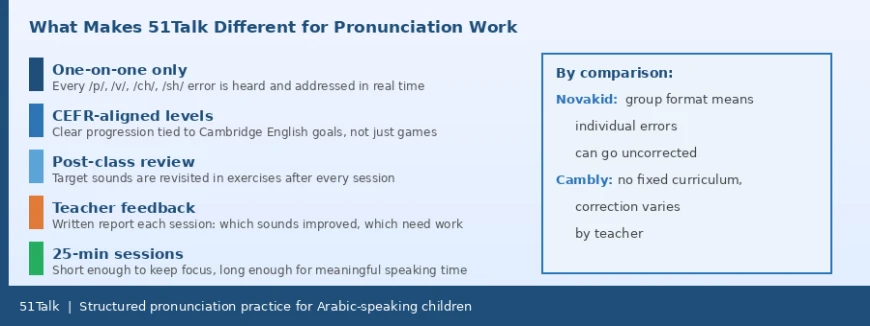
• One-on-one means no hiding. Every /p/, /v/, /ch/, and /sh/ production is heard. There is no group dynamic to absorb errors.
• Post-class review revisits target sounds. Pronunciation is a motor skill. It changes through repetition across sessions, not just within them. The review exercises are the mechanism that makes this happen.
• Feedback reports document specific sounds. Parents can see which phonemes were targeted this week and whether they improved. That makes home practice more focused, not random.
• CEFR progression means pronunciation is not treated as an afterthought. It is embedded in the curriculum structure alongside grammar and vocabulary.
• 25-minute sessions keep focus high. Longer sessions often lose young children halfway through. Short and frequent beats long and occasional for pronunciation work.
What 51Talk cannot guarantee
No online platform can promise a fixed timeline for pronunciation improvement. Progress depends on the child’s age, how often sessions happen, how much practice occurs outside class, and how well the specific teacher matches the child’s learning style. 51Talk can tell you what the curriculum covers and how feedback is structured. Those are verifiable. What any individual teacher will do in a given session is something you learn from a trial lesson.
Ask 51Talk specifically whether teachers receive guidance on Arabic-English phonological transfer before you book. And ask whether feedback reports specify individual phoneme errors or just give general comments. Both questions have clear answers and will tell you a lot.
Parent Checklist: Questions to Ask Before You Enrol
Use this table when evaluating any of the three platforms. A platform that cannot answer these questions clearly is worth pausing on.
| Question to ask | 51Talk | Novakid | Cambly Kids |
| Does the teacher address Arabic-specific errors (/p/, /v/, /ch/)? | Yes, 1-on-1 format ensures this | Depends on group vs 1-on-1 | Depends on teacher assigned |
| Is there a post-class review targeting specific sounds? | Yes | Game-based review, less targeted | No |
| Are feedback reports provided each session? | Yes, written feedback | Badge/level progress only | No standard report |
| Is the curriculum CEFR-aligned? | Yes | Proprietary, not CEFR-labelled | No curriculum |
| Can I request a teacher with Arabic-learner experience? | Ask specifically before booking | Teacher matching by platform | Browse and choose yourself |
| Is there a trial lesson before full commitment? | Yes (verify at 51talk.com) | Yes | Pay-per-lesson, no commitment |
What to Do Next
If English pronunciation correction is your main goal, the platform structure matters more than the brand. One-on-one format, post-class review of specific sounds, and written feedback per session are the three features that distinguish systematic pronunciation work from general English exposure. Of the three platforms compared here, 51Talk’s structure is the most directly aligned with those requirements.
Novakid is the better choice if your child’s primary barrier is willingness to speak. Cambly Kids is the better choice if your child already speaks confidently and needs native-speaker exposure to sharpen their prosody and connected speech. Neither of those goals is minor. They are just different from systematic phoneme correction.
Before committing to any platform, take the trial lesson seriously. Listen to how the teacher responds when your child mispronounces a word. Does the teacher address it specifically? Does the teacher note it for follow-up? That moment tells you more about what the next six months will look like than any feature list does.
Save the trial lesson feedback. Ask for written notes. And if pronunciation is the priority, make sure the platform you choose has a built-in reason to track it.
Frequently Asked Questions
Which platform is best for fixing Arabic-to-English pronunciation errors specifically?
Of the three platforms compared here, 51Talk’s format is most directly suited to this goal. The one-on-one structure means every Arabic transfer error gets heard rather than absorbed into a group dynamic. The post-class review targets the same sounds practised in the live session, which is how motor-level pronunciation correction actually sticks. And the written feedback report per session means parents can see which specific sounds improved and which still need work. Verify current programme details at 51talk.com.
Is Novakid good for young Saudi children who are shy about speaking English?
Yes. Novakid’s game-based format is specifically designed to reduce the anxiety that makes children reluctant speakers. For children aged four to eight who have become self-conscious about pronunciation errors, lowering the stakes first often makes subsequent structured work more productive. If your child refuses to speak in class, Novakid is a reasonable first step. Once they are speaking willingly, moving to a more correction-focused platform is easier.
Does Cambly Kids correct pronunciation errors or mainly just provide conversation practice?
Cambly Kids is primarily a conversation exposure platform. Tutors are native English speakers but there is no standard curriculum or pronunciation correction protocol. Whether a specific tutor addresses Arabic transfer errors depends entirely on that tutor’s background and approach. Some will drill sounds carefully. Others will keep the conversation moving and not interrupt for phoneme correction. If systematic pronunciation tracking is what you need, the inconsistency is a structural limitation, not just a tutor quality issue.
Can I use more than one platform at the same time?
Yes, and for some children a combination works well. For example, 51Talk for structured pronunciation correction during the week and Cambly Kids occasionally for free-conversation exposure. The risk is scheduling overload for young children. If you do combine platforms, make sure the home practice time stays focused on the specific sounds the correction-focused platform is targeting, rather than spreading across multiple systems at once.
How do I know if a 51Talk teacher has experience with Arabic-speaking learners?
Ask directly before your first session. Specifically ask whether the teacher has worked with Saudi or Gulf Arabic-speaking children and whether they are familiar with common Arabic-English phonological transfer patterns like /b/ for /p/ or /f/ for /v/. A teacher who can answer that question specifically is worth booking. A teacher who gives a vague general answer is worth pausing on. The trial lesson is also the right moment to watch how the teacher responds to a mispronounced sound in real time.
What is the right age to start a structured pronunciation programme?
Children between four and eight acquire new sounds most naturally because their phonological systems are still actively developing. Starting structured pronunciation work in this window is generally easier than correcting patterns that have been in place for years. That said, children of any age respond well to explicit one-on-one correction. A twelve-year-old who has been saying “berry” for “very” for six years can correct that pattern in weeks with targeted practice. Earlier is useful. Later is not a reason to wait longer.