She speaks Arabic fluently. She tells stories, argues her case, explains her feelings, and makes her family laugh. But the moment English comes up, she goes quiet. In class she stares at the desk when the teacher asks a question. At home she refuses to practise. She knows more English than she lets on. She just will not speak it.
This pattern is one of the most common things Saudi parents describe when they talk about their daughters and English. It is not a language problem. It is a confidence problem, and the two are different enough that treating one as the other makes things worse, not better. A girl who is pushed harder to speak in front of peers when she is already afraid does not become braver. She becomes more determined to stay silent.
One-on-one online English lessons are the format most directly suited to this specific problem, not because they are better at teaching English in general, but because they structurally remove the conditions that make speaking feel dangerous. This guide explains why girls go silent, how one-on-one lessons change the equation, what parents can do at home, and how to tell whether the approach is working. It does not address speech disorders or clinical anxiety. If your daughter’s silence extends to Arabic as well, a specialist should be consulted.
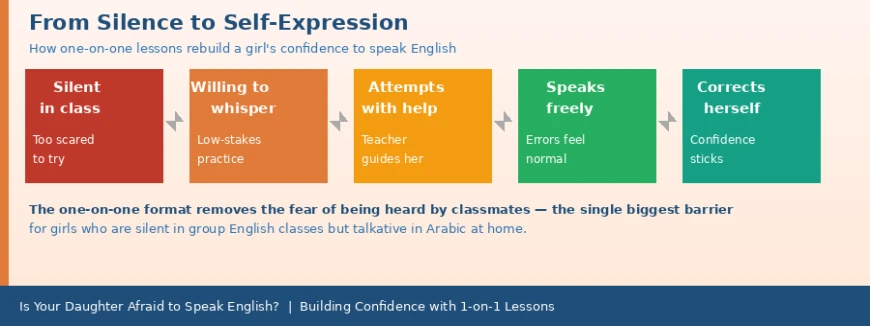
Why She Stays Silent: It Is Not About Language Ability
A girl who speaks Arabic confidently and goes silent in English is demonstrating something specific. She has enough language ability to know when she is likely to make a mistake. She has enough social awareness to know that other people will hear it. And she has decided, consciously or not, that staying silent is safer than being heard getting something wrong.
This is not unusual. Research on second language acquisition consistently shows that speaking anxiety is one of the strongest predictors of language learning outcomes, and that girls in particular are more likely than boys to self-silence when they fear social judgment. The fear is not irrational. It is grounded in real experiences of correction that felt public and unkind, in comparisons with siblings or classmates who seem more confident, and in a school environment where speaking up means taking a risk in front of an audience.
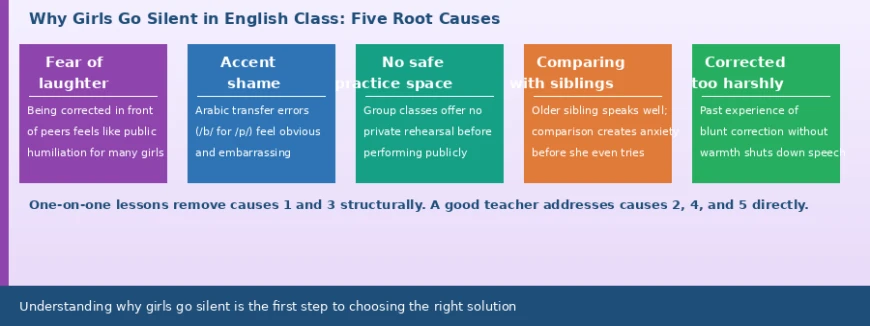
The five most common causes of speaking silence in Saudi girls
Understanding which cause is most active for your daughter helps you choose the right response rather than applying the same approach to every case.
1. Fear of public correction. Being corrected in front of classmates is experienced by many girls as something close to public humiliation, even when the teacher intends it neutrally. A correction that the teacher considers encouraging, saying “good try, but the word is pen not ben”, lands very differently in front of twenty peers than it does in a one-on-one conversation.
2. Accent shame. Arabic-speaking children produce predictable English errors: /b/ for /p/, /f/ for /v/, /sh/ for /ch/. These are transfer errors from the Arabic sound system, not signs of low ability. But a girl who has been laughed at once for saying “berry” instead of “very” may associate that specific sound with the memory of being laughed at and avoid every English word that contains it.
3. No safe rehearsal space. In a group class, every attempt is a performance. There is no moment before speaking publicly where the child can try the word quietly and confirm she has it right before the whole class hears it. The only way to practise is in front of an audience, which is precisely the condition that most silent children are trying to avoid.
4. Comparison with a more confident sibling or cousin. A girl who has an older sibling who speaks English well may decide, often before the age of ten, that English is something her sibling is good at and she is not. This conclusion can be entirely independent of her actual ability level. It is a story she has told herself, and it is resistant to evidence.
5. A previous experience of correction without warmth. A single blunt correction from a teacher, delivered efficiently rather than warmly, can be enough to shut down a sensitive child’s willingness to try for months. What the teacher experienced as a quick fix, the child experienced as evidence that speaking English exposes her to judgment.
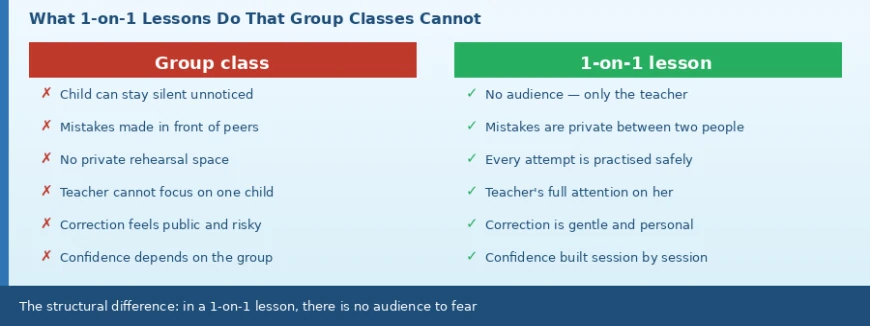
Why Group Classes Make the Silence Worse
Group English classes are not the wrong choice for all children. For a confident child who enjoys the social dynamics of a class, a group setting is motivating and provides useful listening exposure. But for a child who is already afraid to speak, group classes can entrench the silence rather than reduce it.
The mechanism is straightforward. In a group class, every time a child speaks, she speaks in front of an audience. The audience is composed of her peers, whose opinions matter to her, possibly more than the teacher’s opinion does. A girl who is already self-conscious about her accent or her errors experiences every speaking opportunity in a group class as a social risk, not a learning opportunity. The rational response to a social risk you cannot control is to minimise your exposure to it. She stays quiet.
Group classes also cannot address individual sound-level errors in a way that feels safe. When a teacher corrects a specific pronunciation error in a group setting, the correction is by definition made in front of the group. Even if the teacher is gentle, the child knows everyone heard the correction. The association between speaking English and being corrected publicly is reinforced rather than broken.
What group classes cannot provide is a private rehearsal space where the child can try a sound, get it wrong, try it again, get feedback, and try it one more time without anyone except the teacher knowing any of this happened. That is what one-on-one lessons provide.
What 1-on-1 Lessons Change Structurally
The confidence problem in group English classes is not primarily a teacher quality problem. It is a format problem. A skilled teacher who genuinely cares about your daughter’s confidence cannot change the fact that in a group class, your daughter speaks in front of an audience. One-on-one lessons change that specific condition at the structural level.
No audience
In a one-on-one lesson, the only person who hears your daughter speak is the teacher. If she says “berry” instead of “very”, the teacher hears it, addresses it, and the conversation moves on. No one else knows it happened. No peer is watching. No sibling is present. The social risk of speaking has been removed, not reduced, removed, because the audience that made speaking dangerous no longer exists.
For a girl who has been silent in group classes for months or years, this is not a minor adjustment. It is a fundamentally different experience of what English class is. The first time she makes an error and nothing socially bad happens, the cognitive model that has been keeping her silent begins to shift.
Every attempt is private practice
In a group class, every speaking turn is a performance. In a one-on-one lesson, every speaking turn is practice. The distinction matters because children approach practice differently from performance. In practice, approximations are expected and welcomed. Trying a sound even when you are not sure is the point. In performance, approximations are evidence of inadequacy.
A girl who has learned to treat every English speaking opportunity as a performance that will be judged will not become confident through more performance. She will become more avoidant. But a girl who experiences speaking English as private practice, where the teacher’s response to an error is calm guidance rather than judgment, begins to rebuild the association between speaking and safety.
The teacher relationship is personal
In a group class, the teacher is managing twenty students. She cannot build a personal relationship with any single child during the lesson. In a one-on-one lesson, the teacher knows your daughter’s specific errors, her pace, the sounds she finds difficult, the ones she has been working on, and the corrections that have landed and the ones that have not. A girl who trusts her teacher is far more willing to attempt sounds she is afraid of than a girl in a group class who knows the teacher will move on regardless of whether she attempts anything.
Correction is private and specific
One-on-one correction is fundamentally different in character from group correction. When the teacher says in a one-on-one session, “that was /b/, we need /p/, watch my lips”, no one else heard the error or the correction. The child can attempt the sound again and the teacher can confirm it without anyone observing the process. The correction cycle that pronunciation work requires, error noticed, sound named, position demonstrated, repeat attempted, progress confirmed, can run completely without the social exposure that makes it feel dangerous in a group.
Recognising the Stages of Confidence Recovery
Confidence in speaking English does not return all at once. It comes in stages, and each stage is worth recognising because parents who do not see the stages often conclude that progress is not happening when in fact it is. The table below maps the five stages of confidence recovery, what each one looks like in practice, and what parents and teachers should do at each stage.
| Stage | What you observe | What it means | What to do next |
| Willing to whisper | She responds to the teacher quietly; does not go silent when asked a question | The one-on-one space feels safe enough to attempt an answer | Do not push for volume; let her stay quiet. The willingness to attempt is progress |
| Attempts with prompting | She tries to produce a sound or word when the teacher specifically asks, even if the attempt is approximate | She trusts the teacher enough to try in front of them; fear of judgment is lowering | Affirm the attempt before addressing the accuracy; the attempt is the more important thing at this stage |
| Volunteers without being asked | She offers an answer or a word before the teacher specifically calls on her | Self-consciousness is reducing; she is beginning to prioritise expression over fear of error | Let her lead the pacing where possible; do not correct every approximation at this stage |
| Laughs at her own errors | She makes a mistake, notices it herself, and smiles or laughs rather than going quiet | Error has become normal rather than shameful; this is the clearest sign that confidence has genuinely shifted | Reinforce this actively: “yes, that is how we all learn, let us try that one again” |
| Self-corrects unprompted | She produces an error in natural speech, catches it herself, and corrects it without being told to | The correction has become automatic; the sound is beginning to transfer from effortful to habitual | Note the sound and acknowledge the self-correction specifically; this is what long-term progress looks like |
What Not to Do: Common Parent Mistakes That Slow Recovery
Parents who are concerned about their daughter’s English confidence sometimes do things that are intended to help but that inadvertently make the silence worse. These are not failures of care. They are responses that make intuitive sense but misunderstand the nature of the problem.
Pushing her to speak in front of family
Asking your daughter to demonstrate her English in front of relatives, even in a low-stakes way such as saying a few words for a grandparent, reintroduces the audience that one-on-one lessons removed. A girl who is building confidence in a private setting is not ready to perform in a social one. Pushing this too early reverses the progress that the private setting has started to build. Let the confidence consolidate in the lesson setting first. It will transfer to social settings in its own time.
Correcting her English in Arabic conversations
If your daughter uses an English word in casual Arabic conversation and mispronounces it, correcting her pronunciation in that moment, in front of whoever is listening, reinforces the association between speaking English and being corrected socially. Leave pronunciation correction entirely to the lesson setting. In normal conversation, respond to what she is saying, not to how she is saying it.
Comparing her progress to a sibling or classmate
Comparison is one of the five root causes of English silence in Saudi girls. A parent who says, even with good intentions, “your cousin can already say /p/ correctly, maybe try what she does”, is activating exactly the comparison anxiety that the one-on-one environment is trying to reduce. Every child’s confidence recovery follows its own timeline. Comparisons, even positive ones framed as encouragement, do not accelerate it.
Treating willingness to whisper as insufficient progress
A daughter who used to go completely silent but is now willing to whisper her answers has made meaningful progress. If the response to that progress is “speak up, speak louder, stop being shy”, the message she receives is that her current level of courage is not enough. That message does not produce more courage. It produces more silence. Whispered responses are the first stage of confidence recovery. They deserve recognition as progress, not correction as inadequacy.
How 51Talk Supports Confidence Building for Girls
For Saudi families who have identified speaking confidence as the primary barrier, the one-on-one format is the structural starting point. 51Talk’s specific features address several of the confidence-related dimensions that matter alongside the format itself.
What 51Talk is
51Talk is a live one-on-one English platform for children. Sessions are 25 minutes, delivered by qualified teachers, structured around CEFR levels and Cambridge English learning goals. The lesson cycle includes a pre-class warm-up, the live session with real-time correction, post-class review exercises targeted to session content, a written teacher feedback report, and regular level assessments.
Why the format fits the confidence problem
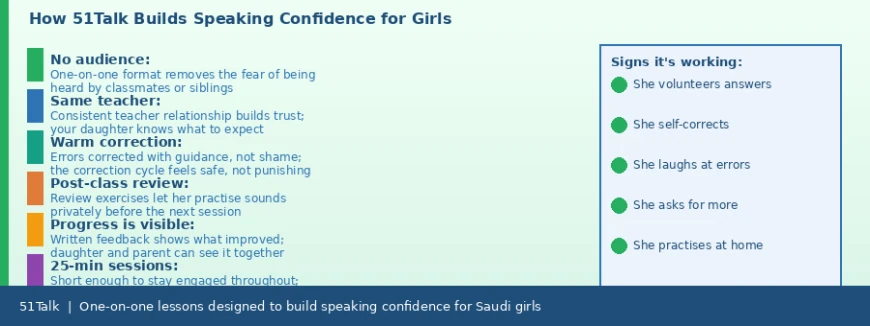
• No audience. The one-on-one format removes the social risk at the structural level. There is no group to perform for. Errors are private between the child and the teacher.
• Consistent teacher relationship. The same teacher across multiple sessions builds a trust that reduces the anxiety of speaking with an unfamiliar adult. A girl who knows what her teacher’s correction style feels like is more willing to attempt sounds she is afraid of.
• Short sessions stay in the attention window. At 25 minutes, the session ends before the confidence that was built in the opening warm-up begins to erode. There is no second half where the child has run out of energy and starts defaulting to silence.
• Post-class review is private practice. The review exercises after each session give the child another opportunity to practise the sounds from the lesson privately, at home, without any audience at all. Private rehearsal builds the motor memory and the confidence simultaneously.
• Written feedback makes progress visible. A feedback report that says the child volunteered an answer today without being asked, or that she self-corrected a /p/ substitution for the first time, gives the parent and daughter a shared language for the progress that is happening.
What to ask before booking
Ask whether you can request a female teacher for your daughter. Ask whether the teacher has experience with children who are reluctant speakers or have speaking anxiety. Ask to see a sample feedback report and check whether it notes the child’s confidence and willingness to attempt, not just the accuracy of what was produced. Ask about the process for switching teachers if the initial match does not feel right for your daughter’s specific confidence needs. A trial lesson is available at 51talk.com.
How Parents Can Support Confidence Building at Home
The lesson setting is where the structured work happens. The home environment is where the conditions are either reinforced or undermined. These eight actions give Saudi parents a specific, practical role in their daughter’s confidence recovery that does not require them to become English teachers.
| When | Action | Why it helps confidence |
| Before lessons begin | Tell her explicitly that mistakes in English class are normal and expected, not embarrassing | Reframing mistakes as learning before the first session changes how she approaches errors from the start |
| Before lessons begin | Ask her what she finds most difficult about English, not to fix it but to understand it | Feeling heard about her specific difficulty reduces the anxiety of having it exposed in a lesson |
| After each session | Ask one specific question about the session, not “how was it” but “what did you practise today” | Specific questions signal that you are interested in her progress; general questions signal you are checking a box |
| After each session | Read the teacher feedback report together and focus on what improved, not what still needs work | Daughters who associate feedback with recognition of progress engage more willingly with correction |
| Between sessions | Let her practise the sounds from the session aloud during daily activities, not as homework but as play | Low-stakes everyday practice builds the motor memory without the performance pressure of a lesson |
| Between sessions | Never correct her English in Arabic in front of other family members | Correction in front of siblings or extended family reinforces exactly the shame that one-on-one lessons are trying to undo |
| When she makes an error | Respond to the meaning of what she said, not to the error, unless she asks for correction | Prioritising communication over accuracy in casual conversation builds the confidence that structured lessons then build accuracy on top of |
| When progress is slow | Point to a specific sign of progress she may not have noticed herself, such as a word she now says correctly without thinking | Girls who cannot see their own progress often conclude they are not capable; a parent who notices it and names it changes that conclusion |
What to Do Next
If your daughter is currently silent in English class but talkative at home in Arabic, the problem is not language ability. It is the association between speaking English and social exposure to judgment. The first step is to remove that association, and the most direct way to do that is one-on-one lessons where there is no audience.
Start with the format question before the platform question. One-on-one is the non-negotiable. Then find a teacher who understands that confidence-building takes priority over accuracy-building in the early stages, and who can tell you specifically how she handles a child who goes quiet rather than attempting a sound.
Let the early sessions be whatever they need to be. If your daughter whispers for the first three sessions, that is forward movement. If she volunteers a word in the fourth session, that is a milestone worth noting. Read the feedback reports together and focus what you say on what improved, not on the gap between where she is and where you want her to be.
The confidence will come. It comes when the environment feels safe enough to attempt, and when the attempts produce guidance rather than judgment. One-on-one lessons create that environment. The rest follows.
Frequently Asked Questions
Can 51Talk match my daughter with a female teacher who specifically has experience with reluctant speakers?
Ask this question directly when enquiring with 51Talk before booking. Specifically request a female teacher and mention that your daughter has speaking anxiety or is reluctant to attempt English aloud. Ask whether the teacher has worked with children in this situation before and how she typically approaches the first few sessions with a shy learner. A teacher who can describe her approach specifically, rather than offering a general assurance that she is patient, is the one worth booking. A trial lesson is available at 51talk.com to see the approach in practice before committing.
My daughter is twelve and has been silent in English class since she was eight. Is it too late to change this?
No. Speaking anxiety and the silence that accompanies it are not permanent states. They are the product of an association, between speaking English and experiencing social risk, that was built through experience and can be rebuilt through different experience. Twelve-year-olds respond to one-on-one confidence-building as well as younger children do, sometimes better, because they have more capacity to understand and engage with the process. The timeline for a twelve-year-old is not necessarily longer than for an eight-year-old. What changes the speed is how consistently the private, low-stakes practice happens and how the teacher handles the early sessions.
She refuses to even try the lesson. How do I get her started when she will not engage?
Do not frame the trial lesson as an English lesson. Frame it as a conversation with someone who wants to hear what she has to say. If she is reluctant, sit with her for the first session and let her observe more than she participates. Let her end the session if it becomes too uncomfortable. The goal of the first session is not pronunciation practice or vocabulary acquisition. It is one encounter with a one-on-one English setting that does not end with her feeling worse than she did at the start. If that happens, book a second session. Build from there, one non-catastrophic experience at a time.
My daughter will try in the lesson but will not practise at home. Should I push her?
Do not push. A daughter who attempts sounds in the lesson but refuses to practise at home is protecting the separation between the safe private space (the lesson) and all other spaces (where she is not ready yet). Pushing practice in other settings before she is ready undoes the confidence that the lesson is building. Instead, make the review exercises as low-stakes as possible: leave them open on the device and let her do them when she feels like it, rather than scheduling them as homework. Over time, as her confidence in the lesson grows, the boundary between the lesson space and other spaces will soften on its own.
How do I know whether the lessons are building confidence or just going through the motions?
Watch for the five stages described in the progress table. The most reliable early signal is not accuracy but willingness to attempt: does she try sounds she refused to try two weeks ago, even if the attempt is approximate? The most reliable later signal is self-correction: does she catch her own errors in natural speech without being told to? If neither is happening after six to eight consistent sessions, ask the teacher specifically what she observes about your daughter’s confidence and willingness to attempt. A teacher who can tell you in specific terms what has changed, and what she is doing to build on it, is tracking the right thing. A teacher who gives you only accuracy-based feedback may be missing the confidence dimension entirely.
Should I tell my daughter’s school teacher about the one-on-one lessons?
You do not need to unless you want to. One-on-one lessons are a supplement to school English, not a replacement. However, if your daughter’s school teacher is aware that she has speaking anxiety and is working on it, the teacher can create more low-stakes speaking opportunities in class, avoid calling on her unexpectedly, and stop interpreting her silence as disengagement. A brief note to the teacher, something as simple as letting them know your daughter is working on speaking confidence and would benefit from voluntary rather than compulsory speaking opportunities, is worth considering if you have a good relationship with the school.