It is one of the most common questions Saudi parents face when choosing an English programme: is it better to have one solid lesson a week, or several shorter ones spread across the days? Both options often cost roughly the same in total time. Both involve the same teacher and the same child. So which one actually produces better results?
The answer is not the same for every child or every learning goal. But for two specific goals that matter most to Saudi parents right now, English pronunciation correction and building consistent speaking habits in children under twelve, shorter and more frequent sessions consistently outperform one long weekly lesson. The reason is not intuitive, and it has nothing to do with how long the lesson feels. It comes down to how memory works.
This guide explains the memory science behind the frequency question, sets out the practical differences between common lesson formats, gives age-specific recommendations, and includes a checklist for evaluating any programme on the frequency dimension. It does not argue that long lessons are never appropriate. They are, for specific goals at specific ages. But the default assumption that longer is better is worth examining before you commit to a programme structure.
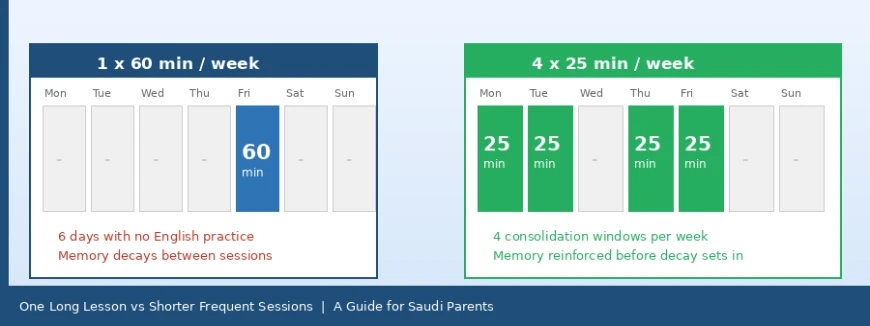
Why Memory Favours Frequency Over Duration
Language learning, and pronunciation in particular, is not primarily about receiving information. It is about building new physical habits in the brain and the mouth. Motor patterns for sounds like /p/, /v/, /ch/, and /sh/ are built through repeated activation of neural pathways, not through a single long exposure event. This changes how you should think about lesson scheduling.
The forgetting curve
Within 24 hours of a learning session, a significant portion of new material is forgotten if it is not reviewed or reinforced. For pronunciation specifically, this is not about forgetting vocabulary words. It is about motor pattern decay: the mouth position that felt new and correct in Tuesday’s lesson starts to drift back toward the Arabic default by Thursday if nothing has reinforced it in between. By the following Tuesday, the teacher is correcting the same /b/ for /p/ substitution that was addressed last week, because the pattern has not had enough practice to become automatic.
This is the core problem with one long lesson per week for pronunciation work. The session may be thorough and well-taught. But the six-day gap between sessions gives the decay curve time to run its full course. The teacher spends a portion of every session re-establishing ground that was lost in the gap rather than building on a stable foundation.
How frequent sessions interrupt the decay
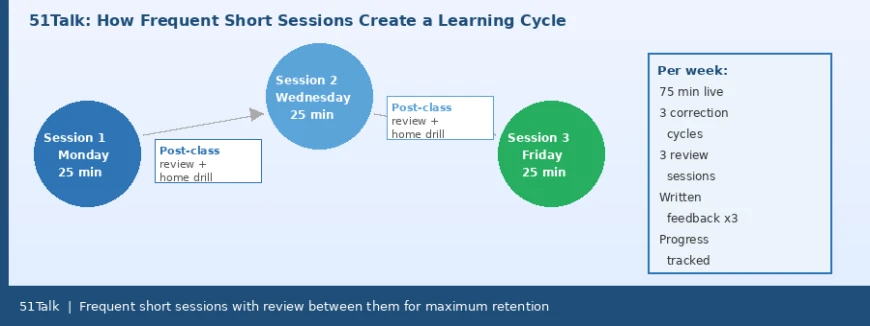
Three sessions per week placed on Monday, Wednesday, and Friday leave a maximum gap of two days between any two sessions. That is inside the window where motor memory consolidation is still active. The Wednesday session lands while the Monday correction is still partially retained, which means the teacher is reinforcing an existing pattern rather than rebuilding it from scratch. The same logic applies from Wednesday to Friday.
This compounding effect is why three 25-minute sessions per week often produces faster pronunciation improvement than one 75-minute session per week, even though the total practice time is roughly the same. The frequency creates multiple consolidation windows. The single long session creates one, and then the forgetting curve runs for six days before the next opportunity arrives.
The role of sleep in consolidation
Motor memory consolidates primarily during sleep. A skill practised in the afternoon is physically different in the brain by the following morning because the overnight consolidation process has run. A child who has a session on Monday, sleeps Monday night, and has a session on Wednesday has had two consolidation events by the time the Wednesday session begins. A child who has one session on Friday has had one consolidation event and then a five-day gap with no reinforcement.
This is why daily home practice, even five or ten minutes of targeted drills on the same sounds addressed in the session, adds significant value. Each practice event triggers a consolidation cycle. More cycles mean more durable patterns.
Attention and Speaking Time in Different Formats
The memory argument is the strongest case for frequency over duration. But there is a second argument that applies within each session: attention quality and speaking time.
Attention windows by age
Children aged five to eight maintain high-quality focused attention for roughly 10 to 20 minutes before cognitive fatigue sets in. Children aged nine to twelve can sustain it for 20 to 30 minutes. These are not absolute numbers, and individual variation is real. But they are useful benchmarks for thinking about session length.
A 60-minute lesson with a seven-year-old does not deliver 60 minutes of effective learning. It delivers roughly 20 to 25 minutes of high-quality engagement, then a gradual drop in processing quality for the second half. The lesson is not wasted, but the retention from the second half is substantially lower than from the first. A 25-minute session that ends before the attention curve bends downward delivers its full 25 minutes at peak quality.
Speaking time per child across formats
In a one-on-one 25-minute session, an active child speaks for roughly eight to twelve minutes. That number sounds modest, but it is speaking time with real-time correction on every production, which is the only kind of practice that directly improves pronunciation.
In a 60-minute group class with six to eight children, each child speaks for approximately five to eight minutes on average. The session is longer but the individual speaking time is lower, and the correction density is much lower. Errors that would be caught and addressed immediately in a one-on-one session pass unnoticed in a group because the teacher is managing multiple children and the lesson must keep moving.
Frequency compensates for session length. Three 25-minute one-on-one sessions per week give a child 24 to 36 minutes of corrected speaking time per week. One 60-minute group session per week gives approximately five to eight. The difference is not marginal.
When a Longer Single Session Makes Sense
Frequency is not always the right answer. There are situations where a longer single session is more appropriate, and being clear about those helps parents make the right choice for their specific child rather than applying a blanket rule.
Older children with content-heavy goals
A thirteen-year-old preparing for an IELTS exam or working through extended writing and grammar content genuinely benefits from longer sessions. The volume of material that needs to be covered in exam preparation does not always fit comfortably into 25 minutes without fragmentation. For this age group, 40 to 50 minute sessions two to three times per week is often a better balance than five 20-minute sessions.
When scheduling constraints are real
Saudi family schedules are genuinely demanding. School, religious commitments, family activities, and travel all compete with lesson time. If three sessions per week is simply not achievable consistently, two sessions per week with strong post-session home review is better than an irregular pattern of three sessions where attendance drops over time. A consistent two-session week beats an inconsistent three-session plan every time.
When the child is building conversational confidence, not drilling accuracy
For a child who already produces the target sounds reasonably well and is working on fluency, confidence, and natural conversation flow, a longer, more relaxed session once or twice a week can be appropriate. Fluency development has a different profile from pronunciation accuracy work: it benefits from sustained conversation, which longer sessions accommodate better than multiple short ones.
The key distinction is the goal. If the goal is pronunciation accuracy, specifically fixing Arabic transfer errors like /b/ for /p/ or /f/ for /v/, frequency is more important. If the goal is conversational fluency in a child who already produces sounds adequately, format is more flexible.
Format Comparison: Three Common Options
This table compares three scheduling formats across the dimensions that matter most for Saudi children learning English pronunciation.
| 1 x 60 min/week | 2 x 30 min/week | 3-4 x 25 min/week | |
| Total weekly practice time | 60 min | 60 min | 75-100 min |
| Consolidation windows/week | 1 | 2 | 3-4 |
| Days between sessions | 6 | 3 | 1-2 |
| Attention quality per session | Drops in second half | Sustained | Fully sustained |
| Pronunciation correction density | Lower: errors decay in 6-day gap | Moderate | High: correction reinforced before decay |
| Post-class review opportunity | 1 per week | 2 per week | 3-4 per week |
| Child speaking time/week (one-on-one) | ~20 min | ~20 min | ~30-40 min |
| Best suited for | Content-heavy, older learners | Balance of content and practice | Pronunciation, accuracy, young children |
| Risk | Forgetting curve not interrupted | Moderate | Low: frequency offsets session brevity |
Age-Based Recommendations
The right session format depends partly on the child’s age, because attention windows, motor plasticity, and content load change as children develop. Use this table as a starting point and adjust based on your child’s specific goals and schedule.
| Age | Recommended format | Primary goal | Session length | Home practice | | 4-6 | 3-4 sessions/week | Sound exposure and early habit | 15-20 min | 5 min sound-spotting daily | | 7-9 | 3-4 sessions/week | Pronunciation accuracy (peak window) | 25 min | Paper-puff and throat-buzz drills | | 10-12 | 3 sessions/week | Accuracy + growing content load | 25-30 min | Minimal pair drills, 10 min | | 13+ | 2-3 sessions/week | Exam prep + fluency | 30-40 min | Review + conversation or writing practice |
How 51Talk Is Designed Around Frequency
The 25-minute session format at 51Talk is not a cost-cutting decision. It is a pedagogical one, based on the same memory consolidation principles described in this guide. The format is built for frequent short sessions with structured review between them, which is the delivery model that best serves pronunciation work for children in the five-to-twelve age range.
What 51Talk is
51Talk is a live one-on-one English platform for children. Sessions are 25 minutes, delivered by qualified teachers, structured around CEFR levels and Cambridge English learning goals. Each session follows a cycle: pre-class warm-up that activates content from the previous session, live one-on-one teaching with real-time pronunciation correction, post-class review exercises targeting the specific sounds from that session, a written teacher feedback report, and regular unit assessments for level tracking.
How the frequency model works in practice
• The pre-class warm-up bridges sessions. Before each live lesson, the child reviews vocabulary and target sounds from the previous session. This is the mechanism that interrupts the forgetting curve: the warm-up reactivates the patterns from two days ago before the teacher builds new content on top of them.
• Sessions can be scheduled multiple times per week. The 25-minute format is designed for three to five sessions per week. Multiple sessions at this length do not produce fatigue the way multiple long sessions might, because each one stays inside the child’s peak attention window.
• Post-class review adds a same-day consolidation event. The review exercises after each session are designed around the sounds and vocabulary from that specific lesson. Completing them the same evening adds a consolidation cycle before the first sleep event, which is when motor memory solidifies.
• Written feedback connects sessions. The feedback report after each lesson tells the parent which sounds were addressed. That information guides the home practice between sessions and allows the next session to start from a known baseline rather than from a general re-assessment.
• The teacher builds on known error history. Because the same teacher runs ongoing sessions and has access to previous session notes, corrections build progressively rather than cycling through the same errors repeatedly without tracking change.
What to ask 51Talk
Before booking, ask how many sessions per week the programme recommends for a child working on pronunciation specifically. Ask whether the post-class review changes with each session or follows a fixed template. Ask how the teacher’s session notes are carried forward to the next lesson. And ask whether make-up sessions are available when a session is missed, since frequency depends on being able to reschedule quickly rather than simply skipping. A trial lesson is available at 51talk.com to see the session structure directly.
Parent Checklist: Evaluating Any Programme on the Frequency Dimension
Use this checklist when comparing English programmes. It focuses specifically on frequency, review structure, continuity, and flexibility, which are the dimensions that determine whether a schedule actually delivers the consolidation benefits described in this guide.
| Question | Field | What the answer tells you |
| How many sessions per week does the programme recommend or allow? | Frequency | Less than 3/week for a young child is usually insufficient for pronunciation work |
| What is the minimum gap between sessions? | Scheduling | Gaps of more than 3 days weaken motor memory consolidation for pronunciation |
| Is there a post-class review exercise after each session? | Review structure | Without review, the forgetting curve runs unchecked between sessions |
| Does the review target sounds from that specific session? | Review quality | Generic review is less effective than session-linked sound targeting |
| Is there a make-up policy if a session is missed? | Policy | Frequency depends on being able to reschedule quickly, not skip permanently |
| Does the teacher’s session notes carry over to the next lesson? | Continuity | Without carry-over, each session starts from scratch rather than building |
| Is the written feedback report available after every session? | Reporting | Parents need session-specific reports to guide home practice correctly |
| Can sessions be scaled up in frequency during school holidays? | Flexibility | Holiday periods are high-value windows for intensive short-session work |
What to Do Next
If your child is under twelve and working on English pronunciation, three or more short sessions per week will produce faster improvement than one long weekly lesson with the same total time. The deciding factor is not how thorough the session is. It is how many consolidation windows the child gets before the next session, and whether the review between sessions keeps the motor memory active during the gaps.
If your child is older and working primarily on exam content or fluency, longer sessions two or three times per week may serve them better. The goal determines the format, not the other way around.
When evaluating a programme, ask two questions before anything else: how many sessions per week does this format support, and is there a post-session review linked to the specific content of each lesson? If both answers are satisfactory, the format is sound. If one is missing, ask whether it can be added through home practice before committing.
Frequency is not the only variable that matters in language learning. But for pronunciation, it is the one most parents underestimate and most programmes under-deliver on. A short lesson every other day, followed by ten minutes of targeted review, will outpace a thorough weekly session more often than not. The science is clear on this. The scheduling decision is yours.
Frequently Asked Questions
How many sessions per week does 51Talk recommend, and can I schedule them flexibly around my family’s routine?
51Talk’s format is designed for multiple sessions per week, and the 25-minute length makes frequent scheduling practical for most Saudi family routines. The specific scheduling options and recommended session frequency by age group are worth confirming directly at 51talk.com before booking. When you enquire, ask whether the same teacher is available across multiple sessions per week and how quickly make-up sessions can be arranged if one is missed. Both affect whether the frequency model actually delivers the consolidation benefits described in this guide.
My child has one 60-minute English lesson at school per day. Does that not already count as daily practice?
School English lessons count for vocabulary, grammar, and reading exposure, but they rarely deliver the individual pronunciation correction that moves the needle on Arabic transfer errors. In a classroom of 25 to 30 students, a child who says /b/ for /p/ consistently will almost never have that pattern directly addressed in a 60-minute group lesson. The teacher is managing too many students simultaneously. One-on-one sessions outside school exist precisely to address what group classroom instruction cannot: individual sound-level correction with real-time feedback. They complement the school lesson rather than duplicate it.
If I can only afford two sessions per week, how do I make the most of them?
Space them as evenly as possible across the week. Two sessions on Saturday and Sunday back to back give you far less consolidation benefit than sessions on Monday and Thursday. The gap between sessions is what the consolidation process needs. With only two sessions, the home practice between them becomes more important: ten minutes of targeted review the evening after each session effectively turns each live lesson into a 35 to 40 minute learning event and adds a second consolidation window for free. Ask the teacher to give you a specific three-word target after each session: three words your child mispronounced that you can drill at home until the next session.
My child gets bored in lessons that go on too long. Is that a sign they would do better with shorter sessions?
Almost certainly yes. Boredom and disengagement in the second half of a lesson is the attention curve in action: the child has passed their peak focus window and is no longer processing at full quality. Shorter sessions that end before disengagement sets in produce better retention and less resistance to attending the next session, because the child never associates the lesson with the feeling of it going on too long. If your child regularly disengages after 20 to 25 minutes, sessions of that length scheduled more frequently will produce better outcomes than pushing them through longer ones.
Does frequency matter as much for older teenagers as it does for young children?
Less so, but it still matters. Older teenagers have longer attention windows and more developed working memory, which means they can extract more value from a single longer session than a six-year-old can. But the forgetting curve still applies, and pronunciation motor memory still benefits from distributed practice rather than concentrated weekly blocks. For a fifteen-year-old working on exam preparation, two 45-minute sessions per week is often better than one 90-minute session, for the same consolidation reasons. The gap narrows with age, but the direction of the effect stays the same.
How do I know if the frequency plan is working after a month?
Look for two specific signals. First, is the teacher spending less time re-establishing corrections from two sessions ago and more time building on them? If the Wednesday session references Monday’s correction and advances from that point rather than repeating it, the consolidation is working. Second, does your child self-correct when they produce an Arabic transfer error in natural conversation, without being prompted? Self-correction outside the lesson is the clearest sign that a pronunciation pattern has begun to shift from effortful to automatic. If neither signal appears after four to six weeks of three-session-per-week practice with post-session review, ask the teacher specifically which sounds are being targeted and whether the correction approach is being varied.