Saudi parents choosing online English programmes for their children encounter the term CEFR frequently. Platforms describe their curriculum as CEFR-aligned, teachers reference A2 and B1 goals, assessment reports mention level advancement. But without a clear understanding of what the CEFR levels actually mean and what constitutes genuine movement from one level to the next, these references are hard to evaluate.
This article explains what the CEFR is, what each level means in practical terms for a Saudi child, how long level advancement realistically takes at different session frequencies, and what evidence should appear in an assessment report to confirm genuine progress. It does not address the process for taking formal Cambridge English exams, though it covers the level framework those exams use.
What the CEFR Is and Why It Matters
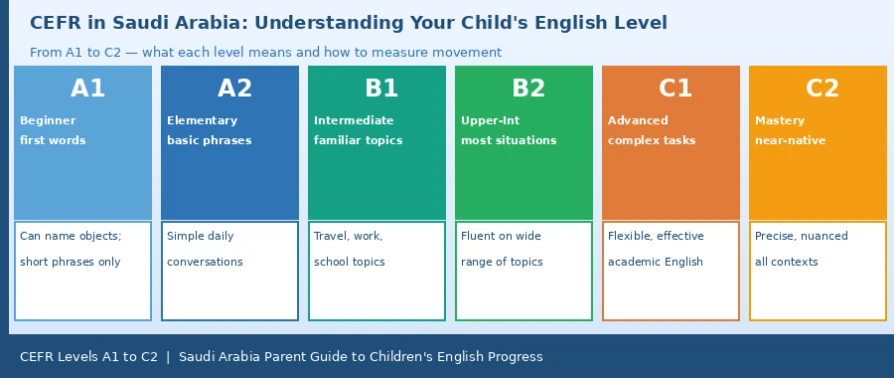
The Common European Framework of Reference for Languages is an international standard for describing language proficiency. It runs from A1 (absolute beginner) through A2, B1, B2, C1, and C2 (near-native proficiency). Each level has defined descriptors: specific things a learner can do in the language at that stage across listening, speaking, reading, and writing.
CEFR alignment matters because it makes progress comparable across programmes and independent of any single platform’s internal labelling system. A child assessed at A2 on 51Talk is at the same level as a child assessed at A2 through Cambridge English, because both use the same framework. A child labelled ‘Level 4’ on an app that does not reference CEFR cannot be compared to either.
For Saudi parents, CEFR alignment is particularly useful because it allows the child’s progress to be communicated clearly to a school, an examiner, or a new programme provider — and because Cambridge English qualifications, which many Saudi families work toward, are mapped directly onto the CEFR scale.
What Each CEFR Level Means for a Saudi Child
A1 is the entry level. A child at A1 can name familiar objects, respond to very simple questions in English, and follow short instructions with visual support. Most Saudi children beginning English instruction before age seven start here. A2 represents basic phrase-level communication: short sentences, simple daily conversations, and the ability to describe familiar situations in English.
B1 is the first fully independent user level. A child at B1 can handle most situations during travel, talk about personal experiences, and write short connected texts. B2 represents upper-intermediate competence: fluency on a wide range of topics, understanding of complex text, and ability to interact spontaneously with native speakers without significant effort.
C1 and C2 are advanced levels. C1 is the entry point for academic and professional English. C2 is near-native proficiency. Saudi children in school-age online programmes typically work between A1 and B2 as their goal range, depending on starting age and programme intensity.
Realistic Level-Advancement Timelines
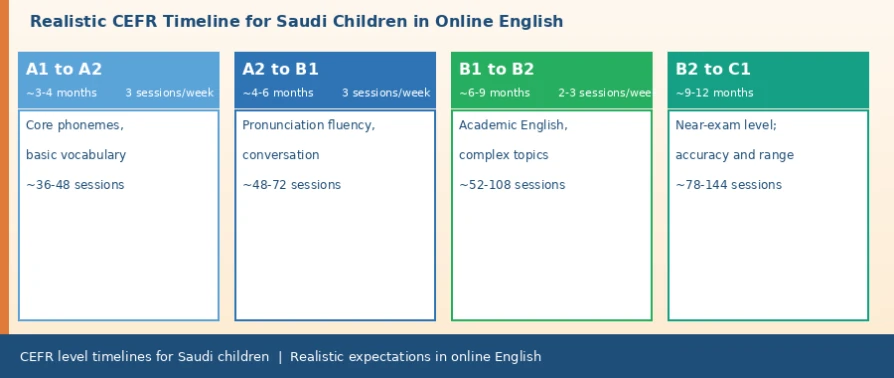
Level advancement timelines depend on three variables that no platform can fully control: the child’s age and starting level, the session frequency, and how consistently home practice is completed. The timelines below assume three sessions per week with post-class review completed the same day as each session.
-
A1 to A2: approximately three to four months, or 36 to 48 sessions. Core vocabulary, basic phoneme accuracy, and simple sentence structures.
-
A2 to B1: four to six months, or 48 to 72 sessions. Pronunciation fluency increases; conversational confidence develops.
-
B1 to B2: six to nine months. Academic vocabulary, more complex structures, near-exam-ready speaking.
At one session per week, multiply these timelines by approximately three. The forgetting curve between sessions erases more of each session’s content at lower frequencies.
What a Valid CEFR Assessment Report Should Include
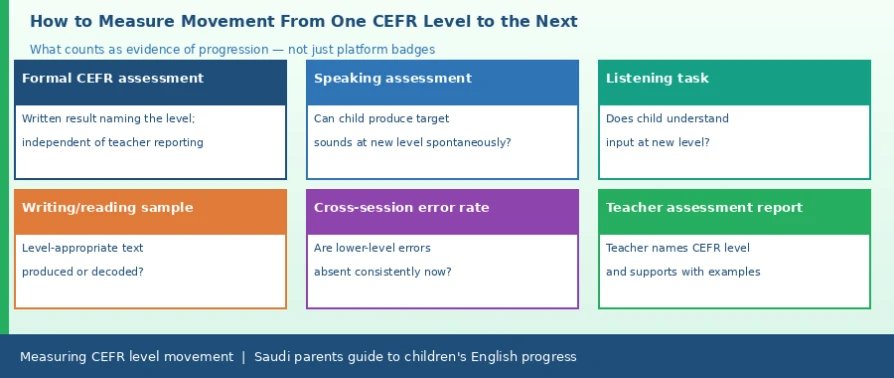
A genuine CEFR assessment report does more than assign a level. It supports the level assignment with evidence across skill areas. Saudi parents should request:
-
The CEFR level explicitly stated (A1, A2, B1, not Level 3 or Star Performer):
-
A breakdown across at least speaking, listening, and reading:
-
Notes on pronunciation accuracy, including Arabic transfer errors if present:
-
The curriculum entry point that the assessment recommends:
-
A reassessment timeline (typically every six to eight weeks):
An assessment that produces only a badge, a star rating, or a programme-internal label without CEFR reference is not a CEFR assessment regardless of how it is described in marketing materials.
| Assessment feature | Strong report | Weak report |
| CEFR level stated | Yes, explicitly (e.g. A2) | ‘Level 3’ or internal label only |
| Skill breakdown | Listening, speaking, reading noted | Overall score only |
| Pronunciation detail | Arabic transfer errors named | ’Pronunciation: good’ |
| Curriculum connection | Recommends specific curriculum entry | ’Suitable for beginner programme’ |
| Reassessment schedule | Specified (e.g. every 8 weeks) | Not mentioned |
Where 51Talk Fits in CEFR Tracking
What 51Talk is
51Talk is a live one-on-one English platform for children. Sessions are 25 minutes, structured around CEFR levels and Cambridge English learning goals. The lesson cycle includes a pre-class warm-up, the live session with real-time correction, post-class review exercises, a written teacher feedback report, and regular CEFR-aligned level assessments.
Why the CEFR alignment matters for Saudi families
-
Curriculum is level-specific: the content your child covers at A2 corresponds to internationally defined A2 outcomes, not an internal label.
-
Level assessments produce written results: parents receive a documented CEFR level after each assessment period.
-
Cambridge English goals: the curriculum targets align with Cambridge qualifications, which many Saudi families use for university applications.
-
Feedback tracks toward benchmarks: session reports note progress toward the next CEFR level, not just session-by-session improvement.
What to confirm with 51Talk
Ask how frequently CEFR level assessments are conducted, whether parents receive a written result with the level explicitly stated, and whether the initial placement assessment identifies specific CEFR level. Ask for a sample assessment report before enrolling. A trial lesson is available at 51talk.com.
What to Do Next
When evaluating any online English programme for your Saudi child, ask directly: is the curriculum CEFR-aligned, and will I receive a written CEFR level result after the placement assessment and at each reassessment? Save the answer. After three months at the recommended session frequency, request the reassessment result and compare it to the initial placement. A genuine level advancement in three months at three sessions per week is evidence the programme is delivering real progress.
Frequently Asked Questions
Does 51Talk provide a written CEFR level result after the placement assessment and at regular reassessments?
51Talk’s curriculum is CEFR-aligned and the programme includes level assessments at regular intervals. Whether the assessment result is provided in writing with the CEFR level explicitly stated is worth confirming directly before enrolling. Ask specifically: will I receive a document or report that says my child is at A2 (or B1, and so on) with evidence for that level? This is a verifiable yes-or-no question with a clear answer. Request a sample assessment report before committing. Check current programme details at 51talk.com.
My child’s platform gives stars and badges but never mentions CEFR. Is that a problem?
Stars and badges are engagement mechanisms, not progress measurements. They tell you the child completed activities and the platform wants to reward that completion. They do not tell you what the child can do in English relative to an independent standard. For Saudi families whose children may need to demonstrate English proficiency for school applications, travel, or formal qualifications, CEFR alignment matters. A platform that uses only internal labels cannot be compared to any external standard.
How do I know if the CEFR level my child is assigned is accurate?
A CEFR level should be supported by evidence from at least three skill areas: speaking, listening, and reading or writing. Ask the teacher or platform: what did you observe in the assessment that puts my child at A2 rather than A1? A teacher who can describe specific examples from the assessment, such as the child being able to hold a short conversation about familiar topics or read a basic description and answer questions, is describing genuine A2 performance. A teacher who says ‘she did well overall’ is not.
What is a realistic CEFR goal for a Saudi child who starts at A1 and attends sessions three times per week?
A child starting at A1 at age seven to nine, attending three 25-minute one-on-one sessions per week with post-class review, can realistically reach A2 in three to four months and approach B1 in nine to twelve months. At one session per week, multiply those timelines by approximately three. These are averages. A child with higher motivation, more home practice, and a teacher familiar with Arabic-English transfer patterns will progress faster than a child with lower frequency and no home reinforcement.