If your child is quiet or hesitant about speaking English, the format of their lessons matters more than the platform, the curriculum, or the price. A group class that works well for a confident child will actively reinforce silence in a hesitant one. A private one-on-one lesson removes the specific condition that makes hesitant children go silent: the audience.
This article gives Saudi and Arab parents a clear framework for deciding between private and group online English lessons for a child who hesitates to speak. It covers the structural differences between the two formats, how group dynamics can deepen avoidance over time, the decision criteria for specific child profiles, and what the research on second language anxiety suggests about format choice.
It does not cover clinical selective mutism or severe language anxiety, which require specialist assessment. It addresses the typical range of shyness and hesitancy that Saudi parents describe when their daughter speaks Arabic freely but clams up in English class.
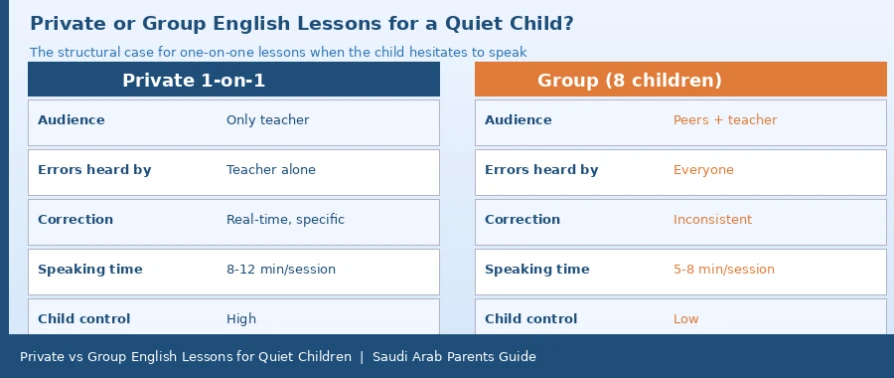
The Core Structural Difference: Who Can Hear the Mistake
In a group English class, when a child mispronounces a sound, everyone in the class hears it. That is the audience. For a confident child, this is background noise. For a hesitant child, this is a recurring public exposure event. Over time, the pattern is: make an error, others notice, feel embarrassed, speak less. The group format does not cause shyness, but for a child who is already hesitant, it reliably deepens it.
In a private one-on-one session, the only person who hears the error is the teacher. There is no audience. The error is private. The correction is private. The repeat attempt is private. The shame spiral cannot start because the social exposure condition that triggers it is absent.
This is not a subtle difference. It is the primary reason private lessons produce different outcomes from group classes for hesitant children, even when the teacher quality is identical.
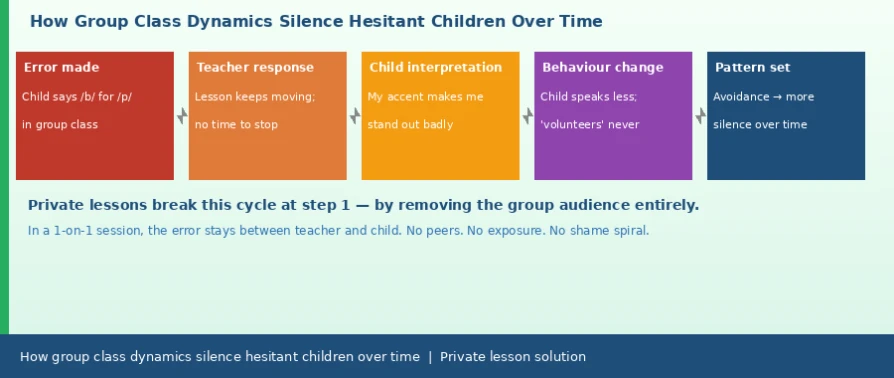
How Group Dynamics Deepen Avoidance Over Time
A child who starts a group English class slightly hesitant rarely becomes more confident through that format alone. The correction cycle that group classes produce for hesitant children runs in the wrong direction: error heard publicly, teacher corrects in front of peers, child interprets this as a signal that speaking exposes her to judgment, child speaks less in future sessions, pattern consolidates.
Private lessons break this cycle at the first step. The error is heard only by the teacher, who corrects it privately and patiently. The child interprets correction as help rather than exposure. She attempts more because attempting does not expose her to peer judgment. The pattern runs in the other direction.
When Group Classes Work for Quieter Children
Group classes are not always wrong for quieter children. There are specific situations where a group format serves them well:
-
The child is socially motivated: some children who are quiet about speaking English are actually more engaged in group settings because the social dynamic of peers makes the activity feel more natural.
-
Confidence, not accuracy, is the goal: if the child’s pronunciation errors are minimal and what she needs is more practice producing English in a social context, a group class can provide that.
-
Group class is supplementary: a child who attends private pronunciation correction sessions separately can also benefit from a group class for fluency and social English practice.
-
The child is 4 to 6 years old: at early ages, the social dimension of a group class is often more important than correction density.
For children who have Arabic transfer errors persisting after years of English instruction and who hesitate to speak, a group class is not the right primary vehicle for pronunciation correction. The correction density is too low and the social risk too high for this specific combination.
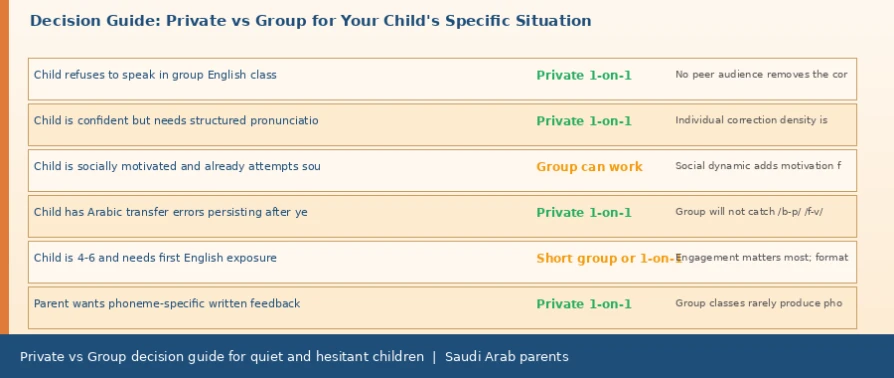
Decision Guide for Saudi Parents
| Child profile | Recommended format | Why |
| Hesitant to speak; Arabic transfer errors present | Private 1-on-1 | Removes audience; correction density is irreplaceable for this profile |
| Confident speaker; needs pronunciation refinement | Private 1-on-1 | Individual correction still needed; group misses too many errors |
| Social and motivated; minimal accent issues | Group can supplement | Peer dynamic helps; supplement with private if errors emerge |
| Very young (4-6); first English exposure | Short 1-on-1 or small group | Engagement-first; correct format less critical at this age |
| Hesitant; resistant to any English practice | Private 1-on-1 | No peer audience is the key; pair with warm, patient teacher |
| Already bilingual; wants conversational fluency | Flexible; group or 1-on-1 | Either can work; depends on child’s preference and goal |
Where 51Talk Fits in This Decision
What 51Talk is
51Talk is a live one-on-one English platform for children. Sessions are 25 minutes, delivered by qualified teachers, and structured around CEFR levels and Cambridge English learning goals. Every session is private: no group format is available. The lesson cycle runs through pre-class warm-up, live lesson with real-time correction, post-class review exercises, a written feedback report, and regular level assessments.
Why 51Talk suits hesitant children structurally
-
No peer audience at any point: the platform has no group option. Every session is private by design.
-
Consistent 25-minute sessions: short enough to fit inside a hesitant child’s courage window.
-
Same teacher booked consistently: trust builds across sessions rather than resetting.
-
Warm correction is possible within the format: ask when booking for a teacher who affirms before correcting.
What to confirm before booking for a hesitant child
Request a female teacher if that is your daughter’s preference. Ask the teacher directly in the booking conversation whether she has experience with shy learners and what her first-session approach looks like for a hesitant child. Ask whether the feedback report will note engagement quality as well as phoneme progress. A trial lesson is available at 51talk.com. Evaluate teacher warmth first; phoneme correction quality second.
What to Do Next
If your child is hesitant and has Arabic transfer errors, book a private lesson first. The group class discussion is secondary. Within private lessons, ask the teacher questions from the pre-booking list above. Run the trial and evaluate teacher warmth and correction style. Only consider adding a group class supplementarily once your child is producing sounds willingly in private sessions.
If you are genuinely uncertain, ask your child directly: does she prefer to be in a group or alone with a teacher? Many children who are labelled as shy by their parents will tell you, if asked directly, that they dislike making mistakes in front of other children. That answer should settle the format question.
Frequently Asked Questions
Does 51Talk offer any group sessions, or is it always one-on-one? Which is better for a quiet child?
51Talk is always one-on-one. There is no group option. For a quiet or hesitant child who hesitates because she fears peer judgment, the one-on-one format removes the condition that drives avoidance. A trial lesson is available at 51talk.com. The trial itself is an opportunity to watch whether the private format changes your daughter’s willingness to attempt sounds compared to the group setting she may already be avoiding.
My daughter is quiet in her group English class but speaks freely in Arabic at home. Which format is right for her?
This is the classic hesitant English learner profile and the strongest case for private lessons. The child has the language ability. She does not have the confidence to use it publicly. The private format removes the public exposure. Most children with this profile show a noticeable change in willingness within three to five private sessions with a consistent, warm teacher.
Can a group class ever help a hesitant child? A parent told me her daughter improved in a group.
Yes, it can work for children who are motivated by social interaction rather than inhibited by it. If your daughter is social in Arabic and enjoys performing for others, she may find a group English class more motivating than a private one. The group format works against hesitancy when mistakes are the main thing the child is afraid of. It works for hesitancy when social interaction is the main thing the child is motivated by. Know which describes your child.
My son is 7 and attends a group English class once a week at school. Do I need private lessons on top of that?
If your son has Arabic transfer errors — /b/ for /p/, /f/ for /v/, or /th/ difficulty — and he is hesitant to speak in English, the school group class is unlikely to address either issue. Group classes at school cover vocabulary and grammar. They do not deliver individual phoneme correction. A private lesson three times per week in addition to school English addresses the specific gap. The two do not duplicate each other.