Your child says “ben” instead of “pen”, or “zis” instead of “this”. You have noticed it for months. Now you are wondering: is this something a good English teacher can fix, or does your child need to see a specialist?
That question comes up a lot for Saudi parents, and the answer is not always obvious. This page explains the difference between pronunciation training and speech therapy, helps you work out which one fits your child’s situation, and sets out what to look for in a programme. It does not replace a professional speech assessment. If your child shows delays in Arabic as well as English, a licensed speech-language pathologist should be your first call.
Why English Pronunciation Is Hard for Saudi Arabic-Speaking Children
Arabic and English are built on very different sound systems. The difficulties Saudi children run into are predictable, well-documented, and have nothing to do with intelligence or effort. They are simply the result of learning a second language whose sounds do not all exist in the first.
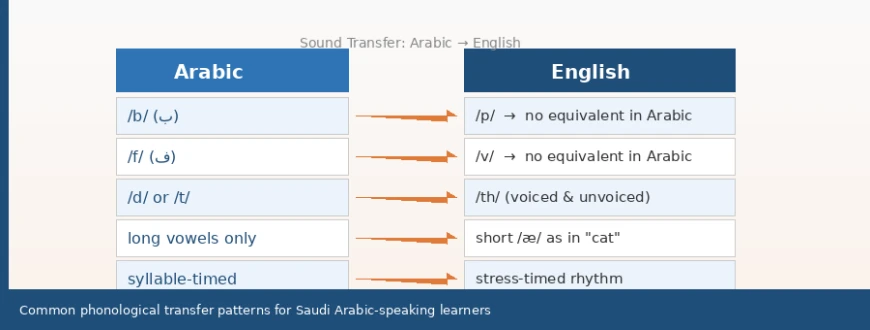
Sounds English has that Arabic does not:
• /p/ - Arabic has no /p/ sound. Most Saudi children substitute /b/, so “pen” becomes “ben” and “park” becomes “bark”.
• /v/ - Often replaced with /f/ or /b/.
• “th” (both voiced and unvoiced) - The /th/ in “the” and “think” are commonly replaced with /d/, /t/, or /z/.
• Short /ae/ vowel - The vowel in “cat” or “man” does not exist in Arabic and tends to be flattened or lengthened.
English is also stress-timed, which means some syllables get stretched and others get swallowed. Arabic is much more even. Saudi children often place equal weight on every syllable, which can make fluent English sound choppy even when the words themselves are right.
These are transfer errors, not disorders. A child making these mistakes is not behind. They are applying the rules of one language to another, which is completely normal.
Signs Your Child Needs Pronunciation Training
If most of the following apply, pronunciation training is the right starting point.
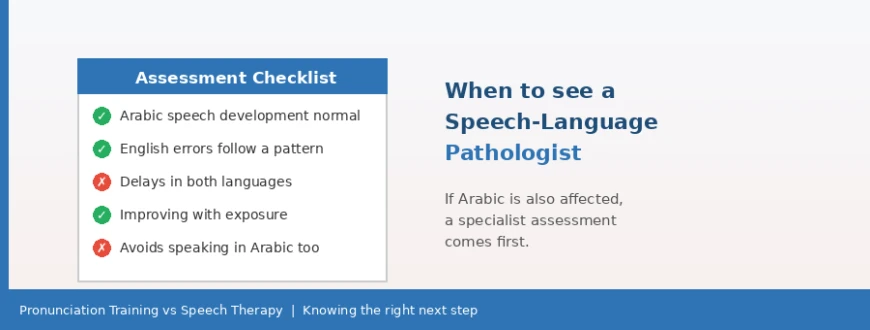
1. Their Arabic is age-appropriate. They speak clearly, tell stories, follow conversations, and express themselves without significant difficulty in Arabic. The gap is specific to English.
2. Their English errors follow a pattern. /p/ always becomes /b/, “th” always becomes /d/. Predictable substitutions point to transfer errors, not processing problems.
3. They understand English better than they produce it. They can follow a story or recognise words but feel unsure when asked to speak. Comprehension is ahead of output.
4. Their English is slowly improving on its own. Even without formal instruction, they pick up new words and phrases. The issue is refinement, not a block.
5. They are quieter in English class but talkative at home. This usually points to confidence and sound-system gaps rather than anything deeper.
Signs Your Child May Need a Speech-Language Assessment
These signals matter regardless of language. If several of these apply, speak to a licensed speech-language pathologist before enrolling in English classes.
1. Their Arabic speech is also unclear or limited for their age. A five-year-old who is still producing very short sentences, frequently misunderstood in Arabic, or omitting many sounds may have a speech or language delay.
2. They struggle to follow multi-step instructions in either language. This points to auditory processing or language comprehension difficulties that cross both languages.
3. They repeat words or sounds involuntarily. Stuttering and cluttering are fluency issues that sit outside the scope of pronunciation training.
4. They avoid speaking altogether, even in Arabic. Selective mutism or significant anxiety needs specialist attention first.
5. Their English has not improved after a year of regular instruction. If core sound production is stuck despite consistent classes, a phonological processing screening is worth requesting.
Pronunciation Training vs Speech Therapy: Side by Side
| Pronunciation Training | Speech Therapy | |
| Who delivers it | Qualified English teacher or EFL specialist | Licensed speech-language pathologist (SLP) |
| Setting | Online or in-person English class | Clinic, school, or telehealth |
| What it targets | English-specific sounds, stress, rhythm, intonation | Underlying speech or language disorders in any language |
| Who it suits | Children with normal Arabic development who struggle with English sounds | Children with delays, disorders, or bilingual processing difficulties |
| Session length | 25-30 min, multiple times per week | Typically 30-60 min, frequency set by therapist |
| Parent’s role | Reinforce vocabulary, encourage daily practice | Follow therapist’s home programme precisely |
| Saudi Arabic transfer issues | Directly addressed (e.g. /p/, /v/, “th”) | Not the primary focus |
| Cost and access | Available online; often more affordable and flexible | Requires specialist; may need assessment first |
Where 51Talk Fits In
Once you have worked out that your child needs pronunciation support rather than speech therapy, the next question is what kind of programme actually delivers that. Here is how 51Talk approaches it.
What 51Talk is
51Talk is a live one-on-one online English platform. Lessons are taught by qualified teachers in 25-minute sessions, structured around CEFR levels and Cambridge English learning goals. Each lesson cycle includes a pre-class warm-up, the live session, post-class review exercises, teacher feedback, and unit assessments. Children work through levels progressively rather than repeating unconnected topics.
Why it works for Arabic-speaking children with pronunciation gaps
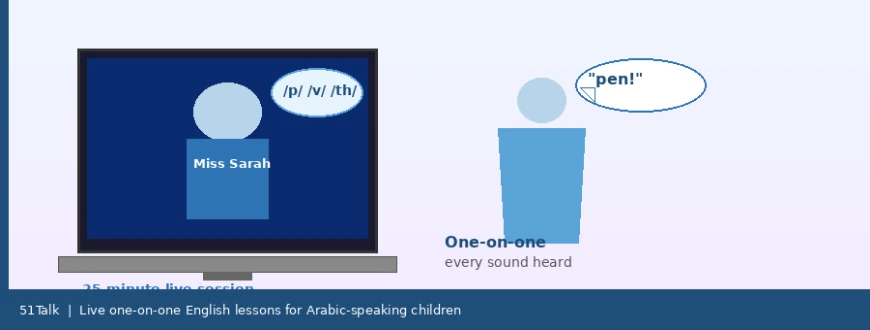
• One-on-one means every sound gets heard. In a group class, a child with Arabic transfer errors can stay quiet or get passed over. In a one-on-one session, the teacher hears every production and can address /b/-for-/p/ substitutions or “th” replacements in real time.
• Review between sessions matters. Pronunciation is built through repetition across lessons, not just within them. Post-class exercises that revisit target sounds help children consolidate the muscle memory they built in class.
• Feedback is documented. Parents can track which sounds are being targeted and whether they are improving, which is much harder to gauge in a group class or self-study app.
• The format is flexible. Sessions are online, 25 minutes, and schedulable around school and family routines. That consistency is important for pronunciation work.
What to keep in mind
51Talk does not specialise in speech therapy. If your child has delays in Arabic as well as English, a speech-language pathologist should be involved first. For children whose Arabic is developing normally and whose English difficulties are transfer-based, the one-on-one structured format is well suited to systematic pronunciation work.
Progress speed depends on age, how often lessons happen, and how much practice happens outside class. 51Talk can tell you clearly what their curriculum covers. What they cannot promise is a fixed timeline, because no programme honestly can.
Before You Enrol: Questions to Ask Any Programme
Use this checklist before committing to any online English class for pronunciation support. A programme that cannot answer these clearly is worth pausing on.
• Does the teacher have training in Arabic-English phonological differences? Knowing why a Saudi child says /b/ instead of /p/ changes how a teacher corrects it.
• Are pronunciation errors tracked individually over time? Single-session corrections are less useful than a record that shows which sounds are improving and which still need work.
• Is there a post-class review element for specific sounds from that lesson? Pronunciation needs repetition across sessions, not just within them.
• How long is the actual speaking time per child? A 25-minute one-on-one gives far more production time than a 60-minute class of eight.
• Is there a trial lesson or placement assessment? You want to hear the teacher interact with your child before making a decision.
• What happens if the teacher and child are not a good match? Ask specifically whether you can request a teacher change and how quickly that is processed.
• How is feedback shared with parents? Ask whether there are written reports, in-app summaries, or just a verbal note at the end of class.
A Quick Note on Raising Bilingual Children
Some Saudi parents worry that pushing English will slow down their child’s Arabic. The research does not support that concern. Bilingual children often develop stronger metalinguistic awareness, meaning they get better at noticing how language works in both directions. The pharyngeal and uvular sounds your child produces naturally in Arabic are genuinely complex consonants. That is not a barrier to English. It is a foundation.
English pronunciation just needs to be taught explicitly for sounds that Arabic does not use. A good teacher shortens that gap, one session at a time.
What to Do Next
Most Saudi children who struggle with English sounds need pronunciation training, not speech therapy. The errors are predictable, the causes are understood, and structured one-on-one practice with a qualified teacher is what moves the needle.
A smaller group of children show signs that go beyond transfer errors: Arabic delays, comprehension difficulties, or no progress after consistent instruction. For those children, a speech-language assessment comes first.
If pronunciation training is the right fit, check what any programme you are considering does with feedback, review, and teacher accountability before you sign up. Ask for a trial lesson. Save the conversation. And if you want a benchmark for what a structured one-on-one programme looks like, 51Talk is a reasonable starting point for comparison.
The goal is straightforward. Your child should feel more confident producing English sounds each month, not more embarrassed. The right programme gets you there.
Frequently Asked Questions
Can 51Talk help Saudi children specifically with Arabic-to-English pronunciation transfer?
That is a fair question to ask directly. What 51Talk offers is qualified one-on-one instruction, post-class review, and documented teacher feedback across CEFR-aligned levels. Whether a specific teacher has direct experience with Arabic-speaking learners is worth asking before you book. The one-on-one format does mean pronunciation errors get caught and addressed rather than overlooked, which is the most important structural feature for transfer-error correction. You can check current programme details and request a trial lesson at 51talk.com.
Is my child’s /b/ for /p/ substitution a speech disorder?
No. Arabic has no /p/ phoneme, so Saudi children naturally substitute the closest Arabic sound, which is /b/. This is one of the most common and well-understood Arabic-English transfer errors. A qualified English teacher who knows this pattern can address it directly. It is not a sign of a speech disorder.
What age should a Saudi child start pronunciation training?
Children who begin structured English exposure between ages four and seven tend to develop more natural-sounding pronunciation than those who start later, partly because the sound system is still being shaped. That said, older children and teenagers can make strong progress too, especially with consistent one-on-one instruction. Starting earlier is useful, but starting late is not a reason to wait longer.
How do I know whether my child’s difficulties are Arabic interference or something else?
Look at how they function in Arabic first. If their Arabic is age-appropriate, clear, and expressive, then English difficulties are almost certainly transfer-based. If Arabic speech is also limited, unclear, or significantly delayed for their age, a bilingual speech-language assessment is the right next step before English classes.
Can speech therapy and pronunciation training happen at the same time?
Yes, and for some children that combination is exactly right. Speech therapy addresses the underlying processing or motor speech issue; English pronunciation training provides structured language-specific input. If your child is already seeing a speech-language pathologist, ask them directly whether adding structured English lessons is appropriate and whether there is anything the English teacher should know.
What “th” words are hardest for Saudi children to learn?
High-frequency words like the, this, that, think, three, and there are the toughest because children encounter them constantly before the sound becomes automatic. Teachers who explicitly target these words early in a lesson plan and return to them in review activities give children the repeated exposure needed to stop defaulting to /d/ or /t/.