Description: A four-dimension guide for Saudi families comparing online English platforms for children — covering age suitability, teacher selection, curriculum structure, and online safety, with a 12-question checklist and full platform comparison table.
How Saudi Families Compare Children’s Online English Platforms:
Age Suitability, Teacher Selection, Curriculum, and Safety
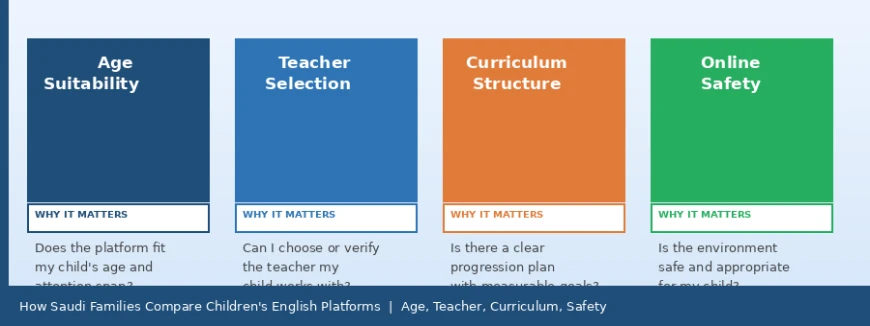
Saudi parents researching online English programmes for their children are comparing more carefully than the platforms’ marketing assumes. The questions that come up most often are not about features but about fit: is this platform actually suited to a seven-year-old, not just a child of unspecified age? Can I choose who teaches my child, or is a teacher assigned to us? Is there a real curriculum or does the teacher decide the lesson content each time? And how does the platform handle the online safety considerations that matter specifically to Saudi families?
These four dimensions — age suitability, teacher selection, curriculum structure, and online safety — are the most practical framework for comparing online English platforms for children. They are also the dimensions that platform websites address least clearly, because they require specific answers rather than general promises. This guide works through all four dimensions systematically, explains what each one means for pronunciation improvement and child welfare specifically, and gives Saudi parents a framework for comparing platforms with the right questions in hand.
The comparison is not a general ranking of online English platforms. Platforms that perform less well on pronunciation correction may perform very well on other goals like conversational fluency or exam preparation. What this guide evaluates is whether each structural feature supports or undermines the specific needs that come up most often for Saudi families.
Dimension 1: Age Suitability
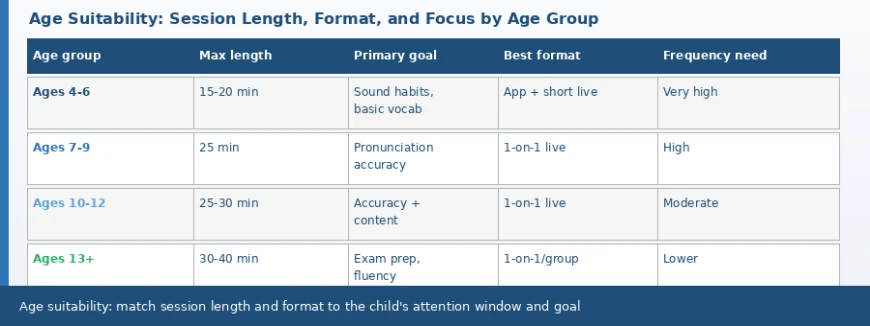
Age suitability is the dimension most frequently misrepresented in platform marketing. A platform that says it serves children aged four to sixteen is technically covering all ages, but a 25-minute session designed around the vocabulary and interaction style appropriate for a ten-year-old is not automatically suitable for a five-year-old. Age suitability covers three specific factors: session length relative to the child’s attention window, the type of activity and interaction used in the session, and the complexity of the curriculum content.
Session length and attention windows
Children aged four to six sustain high-quality focused attention for roughly ten to fifteen minutes. Beyond that, they can remain physically present while their processing quality drops significantly. A session designed for this age group should be fifteen to twenty minutes maximum, with content that shifts activities frequently enough to maintain engagement. A 25-minute session that holds one activity for twenty minutes is too long for a five-year-old regardless of how well the teacher manages it.
Children aged seven to nine can sustain focus for approximately twenty to twenty-five minutes. This is the age range for which the 25-minute one-on-one format is most effective, and also the range where pronunciation work has the highest return because phonological plasticity is still high. Children aged ten to twelve can extend to twenty-five to thirty minutes.
Activity type and interaction style
A platform designed for young children should use short activities, visual prompts, songs, and high-energy interaction that keeps the child moving between tasks. A platform whose sessions consist primarily of reading aloud and answering comprehension questions may be appropriate for a ten-year-old but will lose a six-year-old within five minutes. When evaluating a platform for a young child, ask specifically what the activity structure looks like within a single session and how frequently the activity changes.
Curriculum content complexity
Vocabulary lists, grammar explanations, and reading comprehension exercises are appropriate for older children but not for the four-to-six age group. Young children acquire language through play, repetition, physical response, and song rather than through explicit explanation. A platform that describes its curriculum as suitable for all ages from four to sixteen may mean the content is the same across all ages with the teacher adjusting the delivery, or it may mean there are genuinely age-differentiated materials. Ask which one applies before enrolling a young child.
Dimension 2: Teacher Selection
Teacher selection is the dimension with the greatest impact on outcomes and the least transparency in platform marketing. Most platforms describe their teachers as qualified and experienced without specifying what that means in practice. For Saudi families, teacher selection carries considerations that go beyond the general quality questions.
Can parents choose or influence teacher assignment?
Platforms differ significantly on how much control parents have over teacher assignment. Some platforms assign a teacher based on availability at the chosen time slot with no parent input. Some allow parents to browse teacher profiles and select a preferred teacher before booking. Some assign an initial teacher and allow parents to request a change after the first session. The platform’s system here affects not just the first match but the ongoing consistency of the teacher relationship, which matters for pronunciation work because the teacher who knows your child’s error history is more effective than one who does not.
What to ask: can I specifically request a teacher for my child’s account? Can I browse teacher profiles? If an initial teacher is assigned, how do I request a change and how quickly is it processed?
Gender preference for daughters
Many Saudi families want a female teacher for their daughters. This is not a minor preference; for some families it is a firm requirement. It is also not a requirement that all platforms can consistently meet, because the availability of female teachers at specific time slots depends on the composition of the teacher pool. What to ask: can I request a female teacher specifically? Is a female teacher available at my preferred time slots across multiple days per week? If the primary teacher is unavailable on a given day, is the substitute also female?
Verifying teacher qualifications and Arabic-learner experience
A teacher’s qualification and their experience with Arabic-speaking children are separate things. A TESOL-certified teacher who has only worked with European learners has not encountered the phonological transfer patterns that Saudi children produce. The /b/ for /p/ substitution is automatic and universal among Saudi children learning English, but a teacher who has never encountered it may not recognise the pattern at all. What to ask: does the teacher hold a degree or TESOL/CELTA? Has she worked specifically with Saudi or Gulf Arabic-speaking children? Is she familiar with the common Arabic-English transfer patterns?
Dimension 3: Curriculum Structure
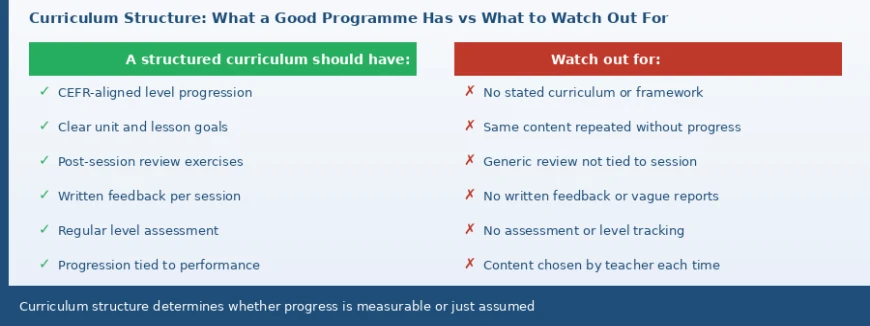
Curriculum structure determines whether a child’s English improves in a systematic, measurable way or whether they enjoy lessons without making clear progress. A well-structured curriculum has a defined progression framework, stated goals for each level and unit, post-session review linked to the specific content of that session, and regular assessments that tell parents where the child is and what comes next.
CEFR alignment
The Common European Framework of Reference for Languages is the most widely used standard for describing English language levels, from A1 to C2. A curriculum that is CEFR-aligned means the content at each level corresponds to recognised international standards, the child’s level can be communicated clearly to a school or examiner, and progress from A1 to A2 to B1 is a meaningful statement rather than an internal platform label. For Saudi families whose children are also working toward Cambridge English qualifications, a CEFR-aligned platform is a practical advantage because the two systems align directly.
Post-session review
A curriculum that includes post-session review exercises is more effective for pronunciation and vocabulary retention than one that does not, because the review interrupts the forgetting curve before it runs too far. The review should be linked to the specific content of the session it follows, not a generic exercise from the current curriculum unit. A child who worked on /p/ and /v/ on Monday should be doing /p/ and /v/ review exercises Monday evening, not a vocabulary list from unit four. What to ask: is a post-session review included? Does the review content change with each session based on what was covered, or is it a fixed template?
Written feedback and level tracking
A written feedback report after each session tells parents what was covered, what improved, and what needs attention. For pronunciation work, the report should name specific phonemes. Level assessments at regular intervals tell parents whether the child is progressing as expected. Ask how frequently level assessments happen, what they cover, and whether parents receive a report on the results.
Dimension 4: Online Safety
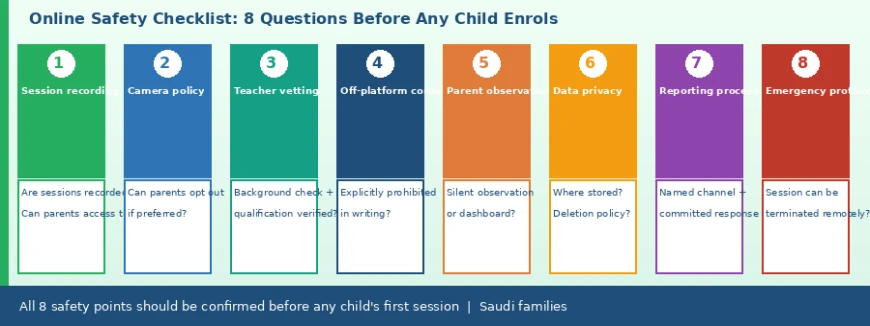
Online safety for children in one-on-one tutoring settings is a dimension that Saudi parents take seriously and that platform marketing often addresses in the broadest terms. Seven specific questions cover the aspects of online safety that apply directly to a child in a live English session.
Session recording and parental visibility
Whether sessions are recorded and whether parents can access those recordings is the most important safety mechanism for young children in one-on-one online settings. A parent who is not in the room during the session has no visibility into what happened unless a recording is available. Platforms that record sessions and make them available to parents on request provide a safety layer that platforms without recording do not. Some platforms allow parents to observe live sessions. For young children, this is worth asking about explicitly.
Teacher conduct and off-platform contact
Any contact between a teacher and child outside the platform itself should be treated as a serious concern and reported to the platform immediately. Reputable platforms prohibit off-platform contact explicitly and have a reporting mechanism for families who encounter it. Before enrolling, ask whether the platform has a written policy against off-platform contact and what the reporting process is if it occurs.
Teacher verification and data privacy
How a platform verifies teacher identity and checks conduct history before hiring is a question with a concrete answer at reputable platforms. A platform that can describe its teacher vetting process specifically is more accountable than one that offers a general assurance. Similarly, session recordings and personal data should be stored on the platform’s own servers, not on the teacher’s personal devices, and there should be a clear policy on who can access them and when they are deleted.
Full Comparison Table: All Four Dimensions
This table compares four common platform types across all four dimensions. Use it alongside the parent checklist below to evaluate specific platforms you are considering.
| | One-on-one live (e.g. 51Talk) | Group live class | On-demand tutoring | Self-study app | | Age 4-6 suitability | Yes (15-20 min) | Only if very short | Limited | Yes (apps work well) | | Age 7-12 suitability | Yes (25 min) | Moderate | Yes with caveats | Supplement only | | Age 13+ suitability | Yes (30 min) | Yes | Yes | Yes | | Teacher selection | Request specific teacher | Teacher assigned | Browse and choose | No teacher | | Female teacher option | Ask platform directly | Depends on school | Browse by profile | N/A | | Pronunciation correction | All errors, real time | Many missed in group | Varies by tutor | Algorithm only | | Curriculum structure | CEFR-aligned | Varies | None | Proprietary | | Session feedback | Written per session | Rarely | None standard | Auto only | | Session recording | Ask platform | Rarely | Rarely | N/A | | Data privacy policy | Verify before booking | Verify before booking | Verify before booking | Verify before booking | | Best suited for | Pronunciation + accuracy | Exposure, social | Fluency/confidence | Vocab supplement |
Online Safety Checklist: Seven Questions Before Any Child Enrols
These seven questions should be answered clearly by any platform before your child attends a first session. A platform that cannot answer them should be questioned further before enrolling.
| Safety point | What to ask | Why it matters for Saudi families |
| Session recording | Are sessions recorded? Can parents access them? | Parents not present during the session need a way to verify what happened — recordings are the primary mechanism |
| Camera and privacy | Is the child required to have her camera on? Can parents disable it? | Some Saudi families prefer the child not to be on camera; verify the platform’s policy before the first session |
| Teacher vetting | What verification steps are taken before a teacher is approved? | A platform that describes its vetting process specifically is more accountable than one that offers a general assurance |
| Off-platform contact | Is teacher-student contact outside the platform explicitly prohibited in writing? | Any off-platform contact between teacher and child should be reported to the platform immediately |
| Parent observation | Can parents observe sessions live or access recordings on demand? | Young children especially benefit from a parent being able to check in — establish this access before it is needed |
| Reporting mechanism | What is the specific channel for reporting inappropriate teacher behaviour? | Knowing the reporting process before a concern arises means you can act immediately rather than searching under pressure |
| Data storage | Where is the child’s data stored? What is the deletion policy? | Saudi family data including child images and session recordings should be handled with explicit privacy protections |
Evaluating 51Talk Across All Four Dimensions
51Talk is the platform most Saudi parents researching this topic will encounter. It is worth going through the four dimensions specifically to identify which are addressed at the platform level and which require direct verification.
What 51Talk is
51Talk is a live one-on-one English platform for children. Sessions are 25 minutes, delivered by qualified teachers, structured around CEFR levels and Cambridge English learning goals. The lesson cycle includes a pre-class warm-up, the live session with real-time correction, post-class review exercises targeted to that session’s content, a written teacher feedback report, and regular level assessments.
Age suitability
The 25-minute session length is well-suited to children aged seven to twelve. For children aged four to six, ask whether the teacher can adapt the session to shorter activity windows and higher-energy interaction. The one-on-one format means the teacher can adjust pacing to the specific child rather than managing a group’s mixed engagement levels.
Teacher selection
Ask 51Talk specifically whether you can request a female teacher and whether she is consistently available at your preferred time slots. Ask whether the teacher has worked with Saudi or Gulf Arabic-speaking children and whether she is familiar with Arabic-English phonological transfer patterns. Ask for the teacher-change process before enrolling.
Curriculum structure
51Talk’s curriculum is CEFR-aligned and structured around Cambridge English learning goals, with clear level progression and regular assessments. Post-class review exercises are part of the lesson cycle. Written feedback reports are included per session. Ask to see a sample report before enrolling to check for phoneme-specific detail.
Online safety
Ask 51Talk directly about session recording availability for parent review, the policy on off-platform teacher-student contact, the teacher verification process, and the data storage and privacy policy. These questions have clear answers at reputable platforms. Ask them before the first session. Check current details and book a trial lesson at 51talk.com.
Parent Checklist: 12 Questions Across All Four Dimensions
Use this checklist when comparing any online English platform. It covers all four dimensions and is designed to be answered before enrolling.
| Dimension | Question to ask or verify | Field | What it tells you |
| Age | Is the session length appropriate for my child’s age and attention window? | Session length | Mismatch causes fatigue and lower retention regardless of content quality |
| Age | Are activities designed specifically for my child’s age group? | Format | Generic adult EFL content delivered to a seven-year-old does not work well |
| Teacher | Can I request a specific teacher or gender preference? | Teacher selection | Preference should be raised before booking, not assumed |
| Teacher | Has the teacher worked with Arabic-speaking children specifically? | Arabic experience | Arabic-learner experience changes how transfer errors are caught and corrected |
| Teacher | What is the teacher-change process if the match is not right? | Policy | A clear, fast process matters; ask before enrolling |
| Curriculum | Is the curriculum CEFR-aligned with stated level progression? | Structure | CEFR alignment gives parents a shared language for measuring progress |
| Curriculum | Is post-class review included and linked to each specific session? | Review quality | Session-specific review is more effective than generic exercises |
| Curriculum | Are written feedback reports provided after every lesson? | Reporting | Phoneme-specific reports guide home practice and track pronunciation progress |
| Safety | Are sessions recorded and available for parent review? | Visibility | Parents of young children especially should have access to session recordings |
| Safety | What is the process for reporting inappropriate teacher behaviour? | Reporting | Knowing the process before it is needed means you can act immediately |
| Safety | How is the child’s personal data and session recording stored? | Privacy | Verify the data policy before any session takes place |
| Safety | Are teachers prohibited from off-platform contact with students? | Conduct policy | Off-platform contact between a teacher and child should never happen |
What to Do Next
Start with age suitability. Confirm that the session length and activity format match your child’s age and attention window before evaluating anything else. A technically excellent curriculum delivered in sessions that are too long for the child’s attention span does not produce the outcomes it promises.
Then work through teacher selection. Raise the gender preference question explicitly and early. Ask about Arabic-learner experience specifically. Confirm the teacher-change process before committing. Check the curriculum structure by asking for a sample feedback report and whether post-class review is session-specific. Address online safety before the first session, not after.
The four dimensions in this guide give Saudi parents a consistent framework for comparison that works regardless of which platform is being evaluated. Apply it to every platform you consider, verify the answers rather than accepting assurances, and use the trial lesson as the final confirmation before enrolling.
Frequently Asked Questions
How does 51Talk handle all four dimensions — age, teacher, curriculum, and safety?
51Talk’s 25-minute one-on-one format is well-suited to children aged seven to twelve for the age suitability dimension. The CEFR-aligned curriculum with post-class review and written feedback addresses the curriculum dimension at the platform level. Teacher selection and safety require direct confirmation: ask whether a female teacher can be assigned, whether she has Arabic-learner experience, whether sessions are recorded for parent review, and what the off-platform contact policy is. A trial lesson is available at 51talk.com to verify correction quality and session structure before enrolling.
My child is five years old. Which platform type is most appropriate?
For a five-year-old, the most important variable is session length. No platform is appropriate at 25 minutes or longer without significant activity variation. A one-on-one platform that allows a teacher to run fifteen to twenty minute sessions with frequent activity changes works better than a group class of the same length. The key is that the sessions feel like play rather than instruction at this age: songs, picture-naming, simple call-and-response, and physical prompts work better than vocabulary drills or reading exercises. Ask any platform you consider how the teacher adapts the session for a five-year-old specifically.
How do I verify that a platform has genuinely checked its teachers’ backgrounds?
Ask the platform to describe its teacher vetting process in specific terms: what documents are required before a teacher is hired, whether background checks are conducted, and whether there is a trial assessment before a teacher is approved to teach independently. A reputable platform can answer these questions specifically. If the answer is a general statement about hiring experienced and qualified teachers without describing the specific process, press for the steps. For 51Talk, ask directly at the point of enquiry before booking.
Is CEFR alignment important if my child is not preparing for a Cambridge exam?
CEFR alignment is useful even without an exam goal because it gives parents and teachers a shared language for describing progress. When a teacher says the child has moved from A1 to A2, that is a meaningful statement with internationally recognised content behind it. CEFR alignment also makes it easier to communicate the child’s level to a school, a new tutor, or an assessment centre if you switch platforms. It is not essential, but it makes progress more transparent and comparable.
What is the minimum safety information I should have before my child’s first session?
Before any first session, confirm four things: whether the session will be recorded and whether you can access the recording; the policy on off-platform contact between teacher and child; how to contact the platform immediately if a concern arises during a session; and where to find the data privacy policy explaining how your child’s personal data is stored. These four pieces of information take ten minutes to confirm and give you the baseline protection you need before a live session begins.